8 Top Industries That Need Professional Translation Services (2026 Guide)
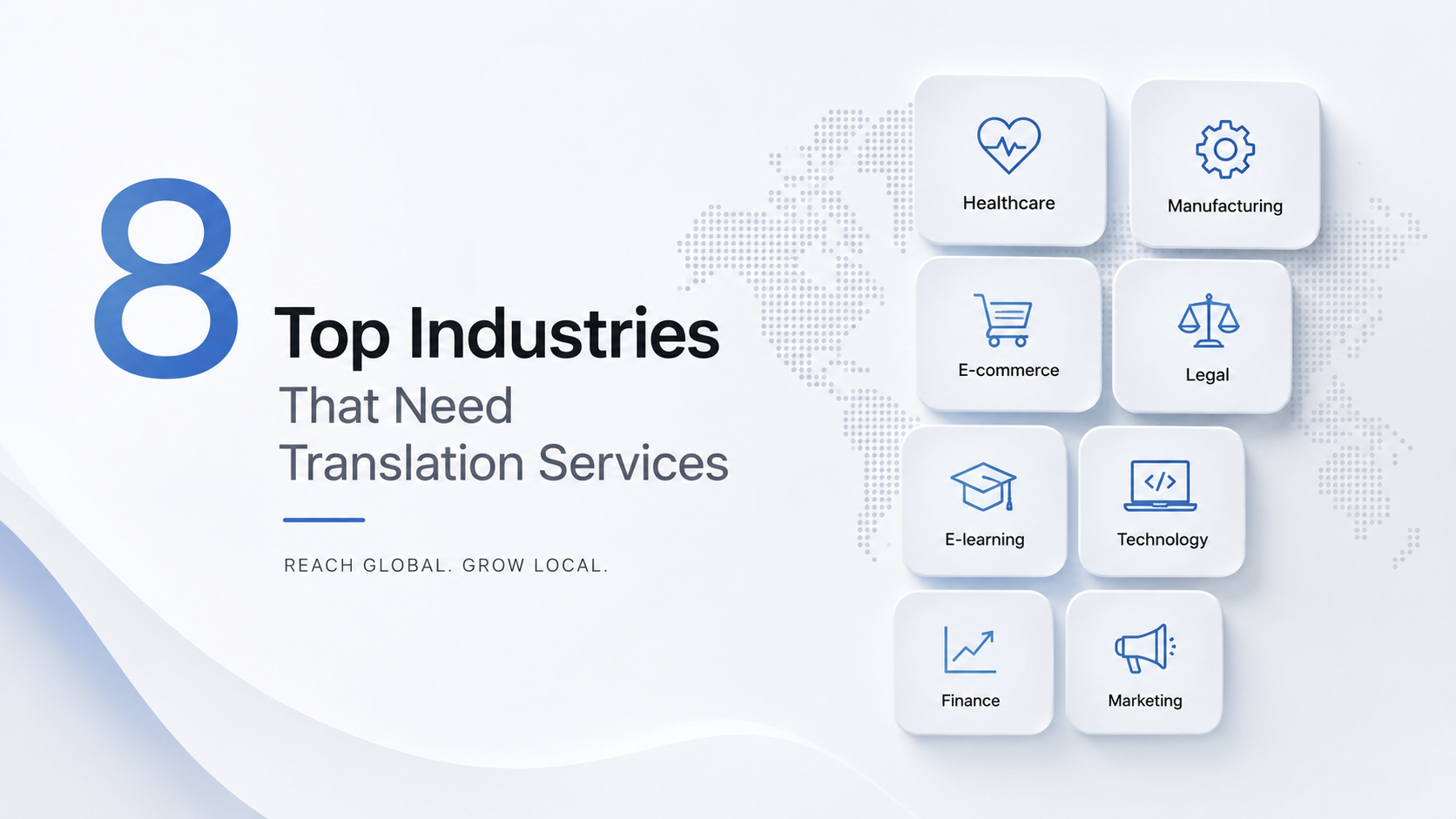
Quick answer: The industries with the greatest need for professional translation are manufacturing, automotive, medical and life sciences, legal, financial, technical and engineering, e-commerce, and e-learning. Each produces high-stakes documentation — safety manuals, contracts, clinical trials, financial filings — where a single error can mean a compliance failure, a safety hazard, or a lost deal. In these sectors, specialist translation isn’t a nice-to-have; it’s a requirement.
Here’s a question worth sitting with: what actually happens when a translation goes wrong?
For a casual blog post, not much. For a pharmaceutical dosage label, a legal indemnity clause, or a machine’s safety warning, the answer is very different — a patient harmed, a contract voided, a worker injured, a product recalled. That gap is exactly why some industries treat translation as a core operational requirement rather than an afterthought.
Not all content carries the same stakes, and not all translation is equal. Some sectors simply can’t operate across borders without accurate, specialist translation done by people who understand the subject as well as the language. Below are the eight industries where that need is greatest — with real examples of what’s at stake, and what each one actually needs translated.
Do follow us on LinkedIn for industrial insights
Why do some industries need specialist
translation more than others?
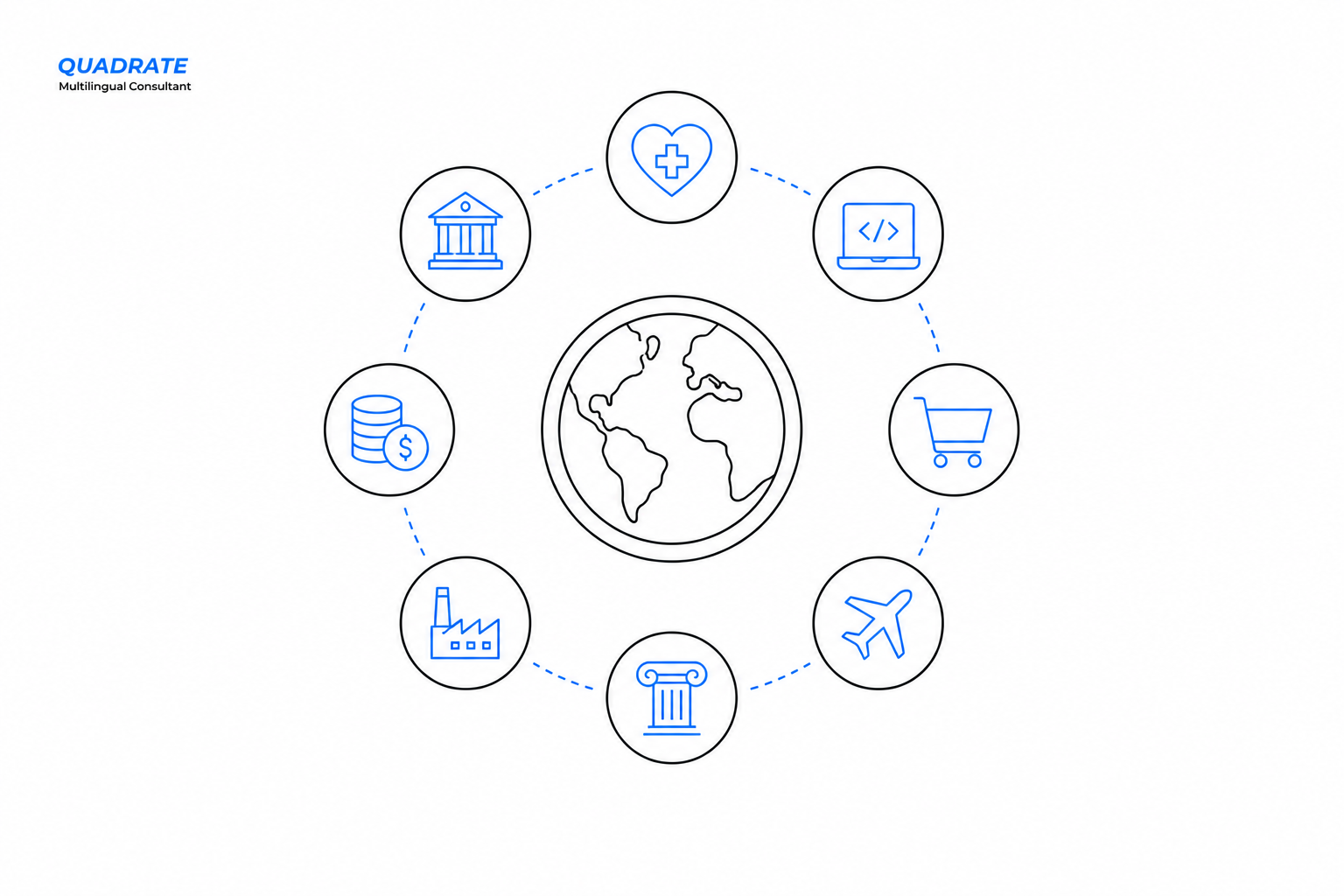
Some industries need specialist translation because their content is technical, regulated, and high-liability — and often legally required in the target market’s language. A manufacturing manual, a clinical trial protocol, a legal contract, or a financial filing has to be accurate to the exact term, because the consequences of getting it wrong are measured in money, compliance, or human safety rather than just readability. General translators and machine tools routinely fail on precisely this kind of terminology. That’s why these sectors rely on linguists with subject-matter expertise, controlled terminology, and human quality assurance.
1. Translation for Manufacturing Industry
Manufacturing is one of the biggest consumers of translation in the world, for a simple reason: manufactured goods cross borders constantly, and their paperwork has to travel with them. Operator manuals, safety data sheets, installation guides, maintenance instructions, and quality documentation all need to be accurate — and in many countries, legally required in the local language before a product can be sold.
Picture this: an Indian machinery exporter ships equipment to Germany with an operator manual where a torque specification or a safety warning was mistranslated. The result isn’t an awkward sentence — it’s an operator over-tightening a component, a warranty dispute, or a workplace injury that traces straight back to one wrong word. In manufacturing, translation is a safety function.
→ Learn more about manufacturing translation services.
2. Translation for Automotive Industry
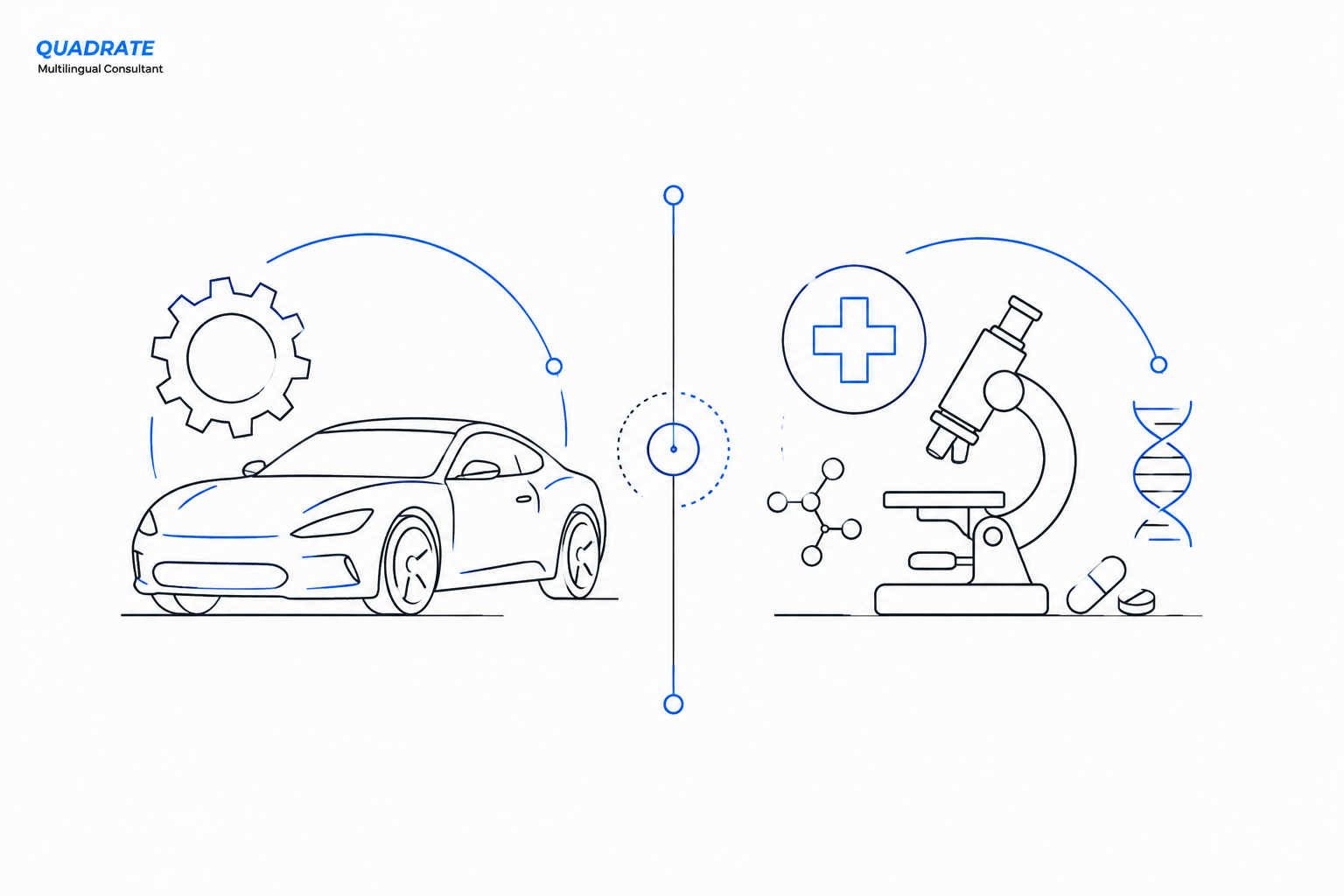
The automotive industry runs on precision across a genuinely global supply chain — a single vehicle can contain parts documented in a dozen languages. Component specifications, OEM manuals, service and maintenance guides, and compliance documents all have to stay consistent and accurate across every market a part or vehicle enters.
For example: as Indian automotive component makers export into European and East Asian markets, their technical documentation has to meet each destination’s standards and terminology exactly. A specification that reads slightly differently in the German version than the English original can mean a rejected shipment or a failed inspection — costly delays caused entirely by language.
→ Learn more about automotive translation services.
3. Translation for Medical-Life Sciences
Few industries carry higher stakes. Medical and life sciences translation spans device manuals, drug information, patient materials, and clinical trials — and here, an error can affect patient safety and regulatory approval directly. Regulators like the FDA and EMA require documentation in local languages, and accuracy is genuinely non-negotiable.
Consider an informed consent form for a clinical trial: it has to be medically precise and readable by a patient with no medical background, in their own language. If a translated dosage or side-effect is wrong, a patient can’t give truly informed consent — an ethical and legal failure, not a stylistic one. This is why medical translation often requires back-translation and independent review.
→ Learn more about medical and life sciences translation and specialist clinical trial translation.
4. Translation for Legal Industries
Legal translation is high-liability by its very nature. Contracts, agreements, patents, compliance filings, and court documents demand absolute precision, because a single mistranslated clause can invalidate an agreement or shift liability onto the wrong party.
Imagine a cross-border sales contract where the jurisdiction or indemnity clause is rendered ambiguously in translation. Months later, in a dispute, that ambiguity is exactly what the opposing side exploits — and a deal that looked airtight unravels over one imprecise phrase. Legal translation frequently requires certification, too, so that courts, registrars, and authorities abroad will accept it at all.
→ Learn more about certified legal translation.

5. Translation for Financial Sectors
Banking, investment, audit, and insurance all depend on financial translation that’s accurate to the decimal and faithful to jurisdiction-specific regulatory language. Annual reports, financial statements, audit reports, prospectuses, and compliance filings frequently need certification, and often have to appear in several languages at once for cross-border offerings.
For instance: an investment firm issuing a prospectus across multiple European markets needs each version to say precisely the same thing — because investors and regulators in each country act on their own language’s version. A discrepancy between the German and French prospectus isn’t just untidy; it can be a regulatory problem.
→ Learn more about financial translation services.
6. Translation for Technical & Engineering
Technical and engineering firms produce some of the most demanding content to translate: user manuals, engineering drawings, CAD documentation, datasheets, and specifications packed with terminology, units, tolerances, and safety symbols. The challenge isn’t just accuracy on any one page — it’s consistency across hundreds of pages and years of revisions.
In practice, a term translated one way in a product’s first manual and differently in its updated version confuses technicians and erodes trust in the documentation. This is why technical translation relies on terminology management and translation memory, so the same term is rendered identically every time.
→ Learn more about technical document translation.
7. Translation for E-commerce & Retail
For e-commerce, translation ties directly to revenue. Product listings, descriptions, checkout flows, size guides, and customer communications all have to be localized — adapted, not just translated — to actually convert shoppers in each market. Customers consistently prefer to buy in their own language, and a store that feels foreign loses sales at exactly the moment of decision.
For example: a product description translated literally might get the words right but the tone wrong — too formal, or culturally off — and a shopper who would have bought instead hesitates and leaves. Good localization removes that friction, so the store feels like it was built for that market from the start.
→ Learn more about e-commerce translation.
8. Translation for E-learning & Education
As online learning has gone global, e-learning localization has become essential. Courseware, LMS content, training videos, assessments, and interactive modules all need to be localized — including synchronized subtitles and voice-over — so a learner in São Paulo gets the same quality of experience as one in Stuttgart.
Consider a corporate compliance course rolled out to staff in eight countries: if the subtitles are out of sync or the on-screen text is left in English, comprehension drops and the training fails its purpose. E-learning localization is what keeps the learning experience equivalent across every language.
→ Learn more about e-learning translation services.
The 8 industries at a glance
| Manufacturing | Manuals, safety data sheets, labels | Safety and legal compliance |
| Automotive | Specs, OEM manuals, compliance docs | Supply-chain accuracy across markets |
| Medical & life sciences | Device info, drug data, clinical trials | Patient safety and regulatory approval |
| Legal | Contracts, patents, court documents | One clause can void an agreement |
| Financial | Reports, filings, prospectuses | Numerical and regulatory precision |
| Technical & engineering | Manuals, drawings, datasheets | Consistency across revisions |
| E-commerce & retail | Listings, checkout, customer content | Directly drives conversion |
| E-learning & education | Courseware, subtitles, assessments | Equivalent learning across languages |

Which industry does your business fall into?
Across all eight, the common thread is the same: specialist translation — by native, subject-matter linguists working under a proper quality system — protects you exactly where generic translation and machine tools fail. The stakes differ by sector, but the principle doesn’t. If your content carries real consequences when it’s wrong, it needs real translation.
Quadrate provides ISO 17100-certified translation across all of these industries in 100+ languages, matching every project to linguists who know the field, not just the language. If you’re need translation services in Chennai, do visit our branch for optimised translation
FAQs – Industry based Translation
Which industries need translation services the most?
Manufacturing, automotive, medical and life sciences, legal, financial, technical and engineering, e-commerce, and e-learning have the greatest need, because their documentation is technical, regulated, and high-liability — often legally required in the target market’s language.
Why do regulated industries need certified translation?
Regulated industries such as medical, legal, and financial services produce documents submitted to authorities, courts, and regulators that must be certified to be legally accepted. Certification confirms the translation is accurate and complete.
What is the difference between general and industry-specific translation?
General translation handles everyday content. Industry-specific translation is done by linguists with subject-matter expertise who understand the terminology, regulations, and stakes of a particular field, ensuring accuracy where errors carry real consequences.
Do manufacturers legally need translated documentation?
Often yes. Many countries legally require manuals, safety data sheets, and labelling in the local language before products can be sold, making translation a compliance requirement for exporters.
Which languages do these industries translate into most?
It depends on target markets — commonly German, French, Spanish, Italian, and Dutch for Europe; Japanese, Korean, and Mandarin for East Asia; and Arabic for the Middle East, alongside Indian languages for the domestic market.
Can machine translation handle industry-specific content?
For rough gists, yes — but for regulated or high-stakes industry content, machine translation frequently mishandles specialist terminology and misses context, creating compliance and safety risks. These sectors rely on human specialist translation with quality assurance.