
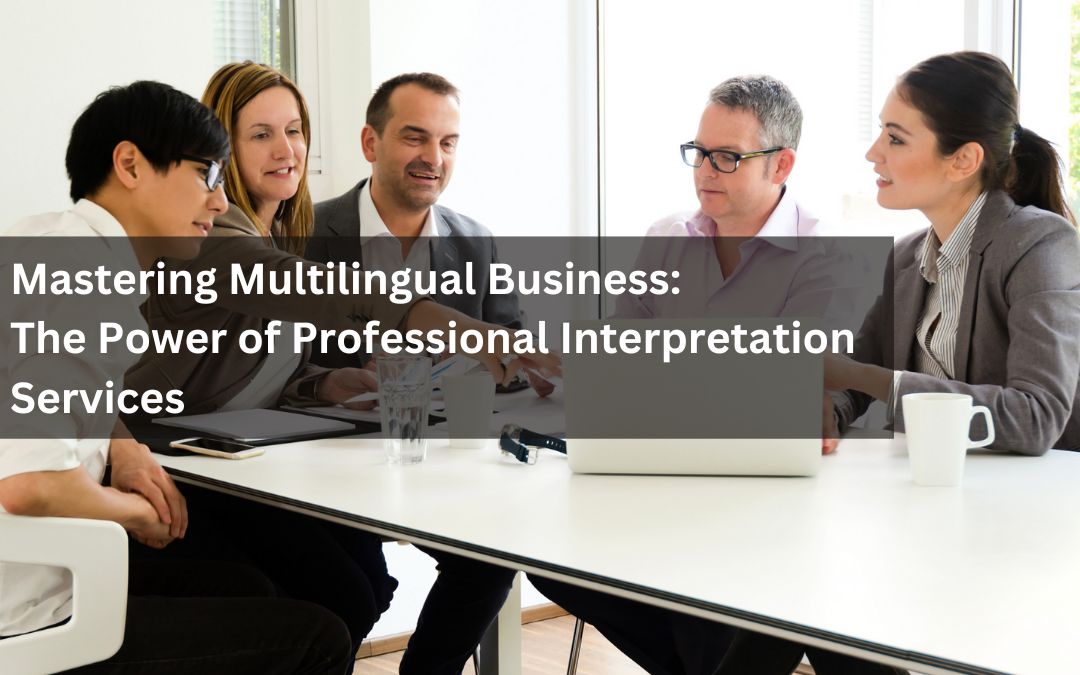
Mastering Multilingual Business: The Power of Professional Interpretation Services
Unlock Multilingual Communication with Accurate Translation Services
The Language Divide in Global Business
Every great deal starts with a conversation — and every misunderstanding starts with a mistranslation.
In the age of globalization, brands no longer compete locally; they communicate globally. Whether in boardrooms, virtual conferences, or international client calls, multilingual communication defines success. Yet far too often, businesses assume that speaking English — or using AI translation apps — is “good enough.”
That’s where they lose ground.
True multilingual business mastery doesn’t come from words alone. It comes from understanding — tone, intent, cultural nuance, and empathy. And that level of understanding only happens through professional interpretation services.
These are not “word converters.” They’re language architects who ensure your brand is heard clearly, respectfully, and accurately across borders.
Let’s unpack how professional interpreters are silently shaping global commerce — and why relying on automated translation tools might be costing your business more than you think.


The Global Language Gap
Why Communication Is Now the Real Edge ?
Globalization has made cross-border business standard — but not seamless. According to a 2024 CSA Research report, over 76% of global customers prefer to buy from brands that speak their language.
Yet miscommunication remains one of the top three reasons international partnerships fail. Not because companies lack vision, but because they lack linguistic alignment.
When a CEO in Tokyo and a supplier in Berlin discuss “delivery schedule adjustments,” the meaning shifts subtly through culture and language. That single nuance can alter tone, cost, and trust.
Where AI and “Bilingual” Solutions Fall Short
AI-driven voice translation tools — like real-time meeting captioning or auto-translation — promise simplicity. They’re fast, scalable, and “good enough” for basic interaction. But in high-stakes business? “Good enough” means risk.
AI tools:
Struggle with accents, idioms, and figurative expressions.
Fail to interpret tone and emotional context.
Cannot mediate cultural sensitivities or unspoken etiquette.
Meanwhile, bilingual employees — though well-intentioned — often lack the specialized training to handle simultaneous interpretation accurately.
Professional interpreters, however, combine linguistic mastery, cultural intelligence, and contextual precision — essential ingredients for success in international business communication.
What Professional Interpretation Really Means
Interpreting vs. Translating — A Crucial Distinction
Translation deals with written words. Interpretation deals with spoken meaning in real time. A professional interpreter listens, processes, and delivers spoken content from one language into another — instantly and accurately — without losing tone or meaning.
Interpretation comes in various forms:
Simultaneous Interpretation: Ideal for conferences and summits; interpreters translate speech in real time through headsets.
Consecutive Interpretation: Common in meetings or negotiations; the speaker pauses for the interpreter to convey meaning.
Whispered (Chuchotage) Interpretation: Used in small settings for one or two participants.
Remote Interpretation: Increasingly popular in hybrid events and online meetings.
In each case, interpreters must capture not only what’s said, but how it’s said — humor, hesitation, confidence, or diplomacy.
The Skill Behind the Silence
Professional interpreters undergo years of training. They must:
Maintain absolute neutrality.
Master industry-specific terminology.
Think and speak simultaneously in two languages.
Adapt instantly to tone, formality, and context.

The Business Power of Interpretation Services
1. Building Trust Across Borders
Trust is built on clarity. When two parties understand each other perfectly, negotiations become smoother, faster, and more transparent.
A misplaced word in an investor meeting can erode confidence. A correct one can seal a multimillion-dollar deal.
Professional interpretation eliminates ambiguity — ensuring intent, not just language, carries across.
2. Enhancing Global Collaboration
Whether it’s a multinational team brainstorming over Zoom or a cross-border merger discussion, interpretation services foster inclusivity.
They level the playing field for non-native speakers, allowing everyone to contribute ideas without linguistic barriers. This directly improves innovation, participation, and morale across international teams.
3. Preventing Costly Misunderstandings
A single translation error in a technical presentation, legal clause, or financial term can cause massive losses.
Interpreters trained in specific industries — such as law, healthcare, or engineering — ensure precision and compliance. That’s not something AI tools or bilingual employees can guarantee.
4. Elevating Brand Reputation
When your brand speaks accurately and respectfully across languages, it signals professionalism and global readiness.
Partnering with professional interpretation services shows clients, investors, and partners that your company values cultural fluency — not just commercial expansion.
Localization isn’t a side task; it’s a statement of respect.
5. Real-Time Adaptability
Unlike AI, human interpreters can adapt to tone, formality, and cultural mood in real-time.
They know when to soften phrasing, emphasize empathy, or balance humor across cultural lines. That adaptability is the heartbeat of effective global communication.

The Pitfalls of Relying on Technology Alone
AI Interpretation: Impressive, but Imperfect
AI has come a long way, especially with real-time transcription and speech recognition. But machine-based interpretation still struggles with the messy, emotional, deeply human way people speak.
Common AI failures include:
Misreading sarcasm or idioms.
Translating technical terms incorrectly.
Inability to adapt to dynamic discussions or interruptions.
Poor handling of multi-speaker environments.
One misplaced nuance in a negotiation can shift tone from collaborative to confrontational. That’s not a “minor error” — it’s a dealbreaker.
Human Context Still Wins
Machines process words. Humans process meaning.
A professional interpreter reads faces, emotions, and pauses — translating not just what is said but why it’s said that way. That’s the difference between linguistic data and business intelligence.
Interpretation in Action — Where It Matters Most
1. International Conferences and Summits
Events like the World Economic Forum or the United Nations General Assembly would be impossible without interpreters. Real-time multilingual communication ensures inclusivity, participation, and clarity among global delegates.
2. Legal and Government Settings
In law and diplomacy, a mistranslation isn’t just embarrassing — it’s dangerous.
Professional interpreters maintain neutrality and accuracy, ensuring all parties’ rights and obligations are clearly understood.
3. Corporate Meetings and Negotiations
Interpreters are vital during mergers, acquisitions, and cross-border investment talks. They make sure both sides negotiate based on shared understanding, not assumption.
4. Healthcare and Life Sciences
In medical interpretation, accuracy can mean the difference between correct treatment and critical error. Certified interpreters ensure clarity between doctors, patients, and international researchers.
5. E-Learning and Corporate Training
As corporations expand globally, internal training and knowledge sharing require interpretation to ensure engagement across cultural and linguistic lines.


The ROI of Professional Interpretation Services
Quantifiable Impact
Companies that invest in language services report:
25–30% higher client retention in multilingual markets.
20% faster project completion through clearer communication.
Increased employee engagement in global teams.
Interpretation directly improves decision-making speed, negotiation clarity, and brand perception — measurable outcomes that affect profit.
Qualitative Impact
Stronger relationships: Partners feel heard and respected.
Fewer errors: Reduced risk in contracts, operations, and compliance.
Enhanced credibility: Your company appears globally mature and culturally intelligent.
Professional interpretation is not an expense — it’s an investment in accuracy, trust, and growth
The Future — Human Expertise Meets Smart Technology
The best localization companies don’t reject AI — they refine
Modern interpretation services integrate AI for note-taking, terminology tracking, and live transcription support, while humans handle nuance, emotion, and decision-making.
This hybrid model means:
Faster setup for multilingual meetings.
Lower operational costs without quality loss.
Enhanced accessibility for global events.
The future of multilingual business communication isn’t AI replacing humans — it’s AI empowering humans to perform better.

Conclusion:
Mastering Multilingual Business Through Human Connection
Global success isn’t just about having the right strategy — it’s about being understood.
Professional interpretation services transform international communication from transactional to relational. They ensure that tone, intent, and respect survive translation. AI may process language, but humans preserve meaning.
In the end, mastering multilingual business isn’t about speaking more languages — it’s about speaking every language well.
Get Your Urgent Translation Now → [Upload Your File / Get a Quote]
Request a Free Quote Today | 24/7 Availability | Serving Pan-India | Certified Translators & Localization Experts