
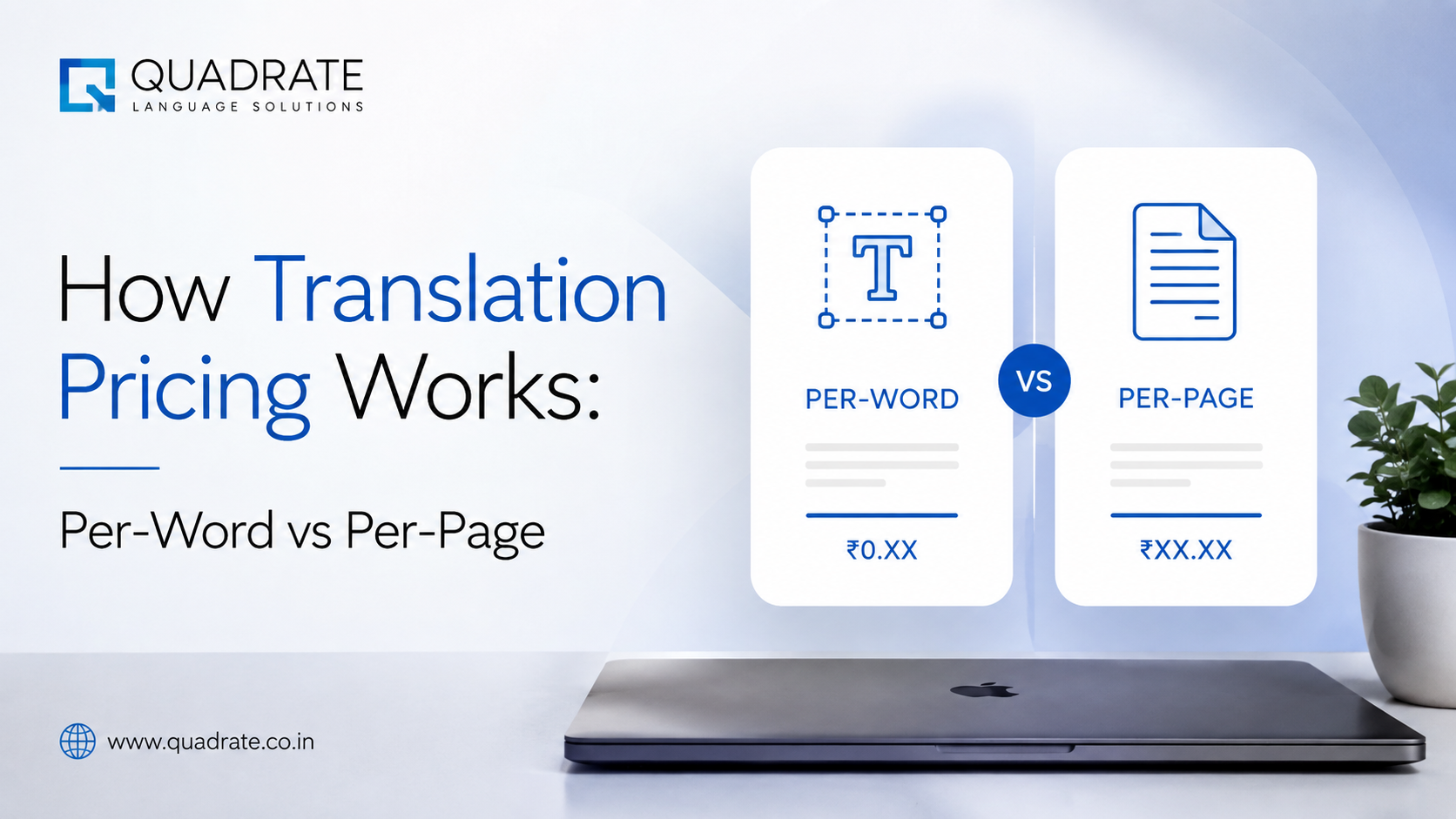
How Translation Pricing Actually Works: Per-Word, Per-Page & Per-Project
Quick answer: Translation is usually priced in one of three ways — per word (the most common), per page (for scanned or fixed-format documents), or per project (for complex or mixed work). The final price depends on the language pair, subject complexity, turnaround, file format, and whether certification is needed. Understanding which model applies helps you compare quotes fairly and avoid surprises.
If you’ve ever asked for a translation quote and been confused by how you were being charged — per word? per page? a flat fee? — you’re not alone. Translation pricing isn’t as standardised as many buyers expect, and two providers can quote the same job in completely different ways. This guide explains how translation pricing actually works, so you can read a quote confidently and understand exactly what you’re paying for.
How is translation usually priced?
Translation is usually priced per word, per page, or per project, depending on the type of content and the provider. Per-word pricing is the global standard for editable text; per-page pricing is common for scanned or fixed-layout documents; and per-project pricing is used for complex jobs that don’t fit neatly into a word count. Each model suits different situations — and knowing which one you’re being quoted under is the first step to comparing providers fairly.
1. Per-word pricing (the most common model)
The global standard for professional translation is per word, calculated on the source document’s word count. It’s transparent and directly comparable: word count × rate = cost. This is why most agencies and freelancers default to it for editable text.
Worked example: A 2,000-word marketing brochure quoted at ₹3/word comes to ₹6,000 for standard translation. If you need it certified (say +30%), that’s roughly ₹7,800. Because the word count is fixed and visible, you can check the maths yourself — which is exactly why buyers like this model.
Rates vary widely, driven mainly by language and complexity (these are illustrative ranges to show how it varies, never fixed rates — always request a quote):
| Factor | Typically lower cost | Typically higher cost |
| Language pair | Hindi, Tamil, Spanish, French | Japanese, Korean, Arabic, rare languages |
| Content type | General, marketing | Legal, medical, technical, financial |
| Source availability | Many qualified linguists | Few qualified specialists |
2. Per-page pricing
Per-page pricing applies when a clean word count can’t be established — typically scanned documents, image PDFs, certificates, and fixed-layout files. Immigration paperwork, legal certificates, birth/marriage certificates, and official documents are usually quoted this way because they arrive as images, not editable text.
Worked example: A 3-page birth certificate quoted at ₹800/page is ₹2,400 — regardless of how many words are on each page. That’s the trade-off: it’s predictable, but a text-dense page and a sparse one may cost the same.
The key distinction buyers miss: a “page” is not a fixed amount of text. This is why per-page pricing is fairest for standardised documents (certificates, forms) and less fair for dense, variable content — where per-word is more accurate.
3. Per-project (flat-fee) pricing
This is one of the hardest features for outsiders. Japanese has keigo — an elaborate system of honorific and humble language that changes the words themselves based on social relationships, status, and situation. The same basic message can be phrased in several levels of formality, and choosing the wrong one can sound rude or oddly stiff. English simply doesn’t have an equivalent system, so translators have to convey that social layer through tone and word choice rather than direct translation — and the nuance is easily lost.
Per-word vs per-page vs per-project — at a glance
| Queries | Per-word | Per-Page | Per-Project |
| Best for | Editable text (Word, web, marketing) | Scanned docs, certificates, fixed layouts | Complex/mixed jobs with extra services |
| How it’s counted | Source word count | Number of pages | Whole job as one figure |
| Transparency | High — easy to verify | Medium — “page” size varies | Lower — ask for a breakdown |
| Most predictable for | Standard documents | Certificates & official forms | Bundled multi-service work |
| Watch out for | — | A page isn’t a fixed word count | Confirm what’s included |
Why “cheap” machine translation isn’t the same product ?
You’ll sometimes see extremely low per-word rates advertised — often these are raw machine translation or lightly-edited machine output (MTPE), not full human translation. They’re different products at different price points.
| Service level | Roughly | What you get |
|---|---|---|
| Raw machine translation | Lowest | Unreviewed AI output — usable only for rough gist |
| Machine + human review (MTPE) | Lower | AI output edited by a linguist — faster, for suitable content |
| Full professional translation | Standard | Human translation + independent review |
| Certified translation | Higher | Professional translation + certification for official use |

What actually affects your translation quote ?
Whichever model is used, the same underlying factors move the price up or down:
- Language pair — rare languages cost more than common ones
- Subject complexity — technical, legal, medical, and financial content requires specialist linguists
- Turnaround — urgent and rush jobs carry a premium
- File format — clean editable text is cheaper than scanned PDFs needing extraction or OCR
- Certification — certified or sworn translation adds cost
- Volume and repetition — large or repetitive content may qualify for savings through translation memory
- Additional services — desktop publishing, subtitling, and formatting add to the total
Why do two quotes for the same job differ so much?
Two providers can quote very differently for the same document because they may use different pricing models, include or exclude different services (review, formatting, certification), assign different linguist tiers, or count the source differently. A cheaper quote isn’t always better value — it may exclude the independent review or certification a more complete quote includes. The key is to compare what’s included, not just the headline number.
How to compare translation quotes fairly ?
To compare quotes on a like-for-like basis, ask each provider:
- Which pricing model are you using (per word, per page, or project)?
- Does the price include independent review/proofreading, or just translation?
- Is certification included if I need it?
- Are formatting and desktop publishing included?
- What’s the turnaround, and is there a rush surcharge?
Once you know these, you’re comparing genuine value — not just numbers.
Getting an accurate translation quote
The most reliable way to know what a translation will cost is simply to share the actual files. A professional provider reviews the content, language pair, format, and requirements, and returns a clear quote with everything included. At Quadrate, we provide transparent, itemised quotes across 100+ languages — so you know exactly what you’re paying for, with no hidden costs.

Frequently Asked Questions – Translation Pricing rates
How is translation usually priced?
Translation is usually priced per word (the global standard for editable text), per page (for scanned or fixed-format documents), or per project (for complex or mixed work). The right model depends on the content type.
Why is translation priced per word?
Per-word pricing is transparent and easy to compare — the cost is based directly on the source document’s word count. It’s the standard model for editable documents like Word files, websites, and marketing content.
When is translation priced per page?
Per-page pricing is used when a word count can’t be easily established, such as scanned documents, PDFs, certificates, and official paperwork that come as images or non-editable files.
What affects the cost of a translation?
The main factors are the language pair, subject complexity, turnaround time, file format, certification requirements, volume and repetition, and any additional services like desktop publishing or subtitling.
Why do translation quotes vary so much between providers?
Because providers may use different pricing models, include or exclude services like review and certification, assign different linguist tiers, or count the source differently. Comparing what’s included matters more than comparing headline prices.
How do I get an accurate translation quote?
Share the actual files with the provider. They review the content, language, format, and requirements, and return an itemised quote — far more accurate than a generic per-word figure.