
How Hard Is It to Translate Japanese? A Beginner’s Guide
Quick answer: Japanese is widely considered one of the hardest languages to translate into English. It uses three writing systems at once, relies heavily on context that’s left unspoken, has multiple levels of politeness built into the grammar, and carries cultural nuance that rarely has a direct English equivalent. A sentence that’s clear in Japanese can have several valid English translations depending on context — which is why machine translation often gets it wrong.
If you’ve ever run a Japanese sentence through a translation app and gotten something that felt “off,” you’ve bumped into one of the genuinely hard problems in language. Japanese and English are about as different as two major languages get — in their writing, their grammar, and the way they carry meaning. This guide explains, in plain terms, why Japanese is so hard to translate, and what makes it fascinating rather than just frustrating.
Why is Japanese so hard to translate?
Japanese is hard to translate because it differs from English at almost every level: it uses three writing systems, its grammar leaves out information that English requires, it encodes social politeness into the language itself, and it depends heavily on context that native speakers simply assume. English, by contrast, tends to spell everything out. Bridging that gap isn’t a matter of swapping words — it’s a matter of reconstructing meaning. Here’s where the real challenges come from.
1. Japanese – Three writing systems at once
Most languages services use one script. Japanese uses three, often in the same sentence:
- Kanji — characters borrowed from Chinese, each carrying meaning, with thousands in common use. A single kanji can have multiple readings depending on context.
- Hiragana — a phonetic script used for grammar, endings, native words.
- Katakana — a second phonetic script, mainly for foreign loanwords and emphasis.
A translator has to read all three fluently and know which reading of a kanji applies in context — because the same character can be pronounced and mean different things depending on the words around it.
Kanji example — add to challenge #1 (writing systems)
For instance, the kanji 生 can be read sei, shō, i, u, nama, ki and more — meaning “life,” “raw,” “birth,” or “student” depending on the word it appears in. The translator has to know which reading and meaning applies each time.
2. Japanese – Grammar that leaves things out
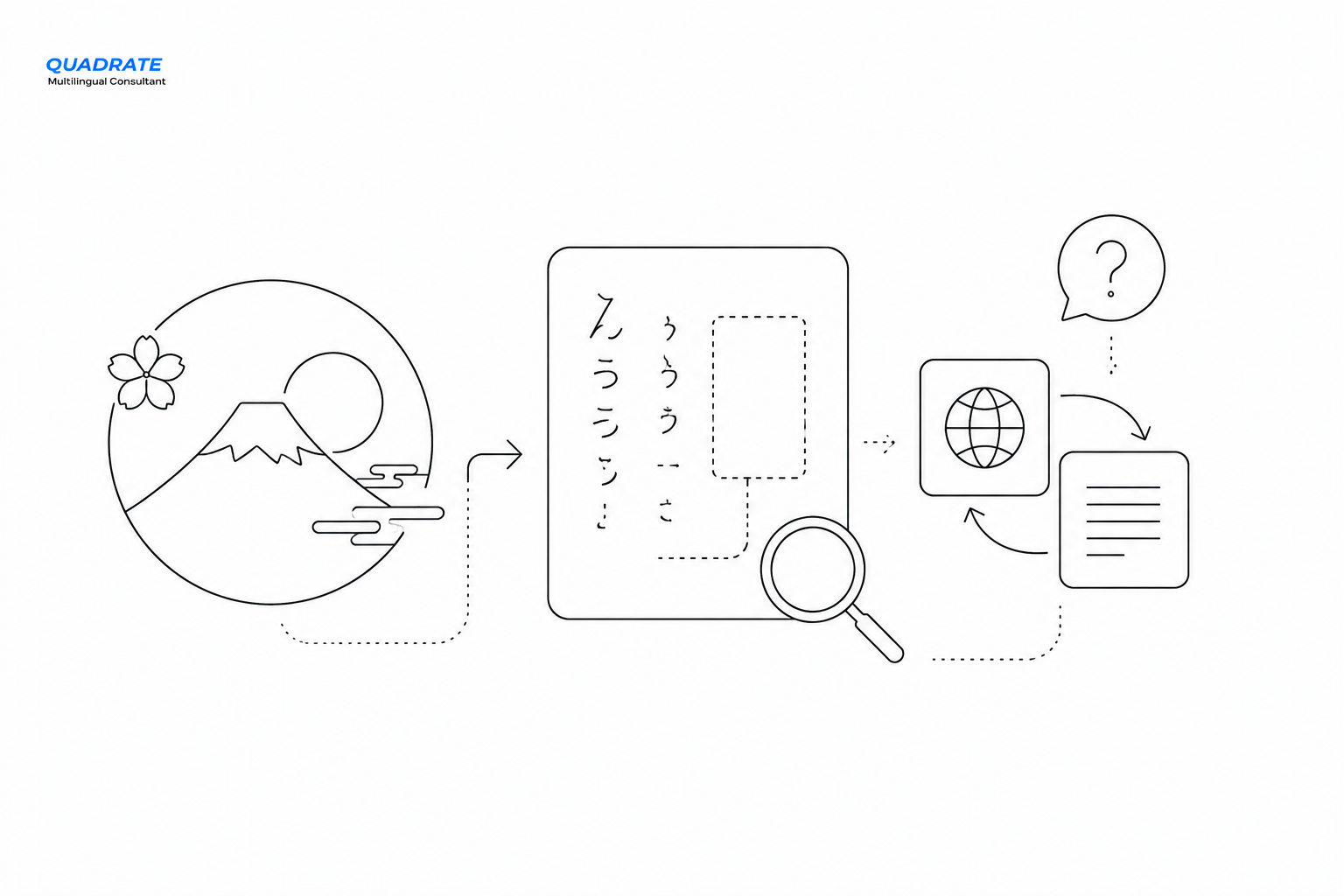
English grammar forces you to specify things Japanese happily omits. Japanese frequently drops the subject of a sentence — “went to the store” might have no stated “I,” “he,” or “she,” because context makes it obvious to a Japanese reader. It also doesn’t mark singular vs plural the way English does, and its verb structure handles time differently. So a translator constantly has to infer and add information — deciding who the subject is, whether something is one or many — that the original never stated. Get the inference wrong, and the English sentence says something the Japanese didn’t.
Here’s a simple example. The Japanese sentence “りんごを食べた” (ringo o tabeta) literally means just “ate an apple.” There’s no “I,” “he,” “she,” or “we” anywhere in it — yet English forces you to pick one. Was it I ate an apple? She ate an apple? They ate an apple? The original is perfectly clear to a native reader from context, but the translator has to read the surrounding text, decide who the subject is, and add a word that was never there. Guess wrong, and the English now says something the Japanese didn’t.
3. Politeness built into the language (keigo)
This is one of the hardest features for outsiders. Japanese has keigo — an elaborate system of honorific and humble language that changes the words themselves based on social relationships, status, and situation. The same basic message can be phrased in several levels of formality, and choosing the wrong one can sound rude or oddly stiff. English simply doesn’t have an equivalent system, so translators have to convey that social layer through tone and word choice rather than direct translation — and the nuance is easily lost.
What makes Japanese hard to translate — at a glance
| Challenge | Why it’s hard for translators |
|---|---|
| Three writing systems | Kanji, hiragana, and katakana appear together; each kanji can have several readings |
| Dropped subjects | Japanese omits “I / he / she”; the translator must infer and add it |
| No singular/plural marking | English forces a choice Japanese never states |
| Keigo (politeness levels) | Formality is built into the words, with no English equivalent |
| High-context meaning | Much is implied, not said — the translator makes it explicit without over-explaining |
| Culture-specific concepts | Some words have no single English equivalent and need a phrase |
4. Japanese – Context and what’s left unsaid
Japanese is often described as a “high-context” language: a great deal of meaning lives in what isn’t said, in shared understanding between speakers. English is lower-context — it states things more explicitly. Translating between them means making the implicit explicit without over-explaining, and knowing when a Japanese phrase is carrying an implication that an English reader would completely miss if translated literally.
5. Japanese – Cultural concepts with no English equivalent
Some Japanese words carry cultural ideas that simply don’t map to a single English word — concepts around aesthetics, social harmony, or emotion that need a phrase or a footnote rather than a word. A good translation preserves the meaning of these, even when a direct equivalent doesn’t exist.
Do follow us on LinkedIn for how to translate Japanes language effectively

Why does machine translation struggle with Japanese?
Machine translation struggles with Japanese precisely because of everything above: it can’t reliably infer an unstated subject, it often picks the wrong reading of a kanji, it flattens the politeness levels, and it misses context and cultural nuance. For a quick gist of a Japanese sentence, machine translation is useful. For anything where accuracy, tone, or nuance matters — business, legal, marketing, or published content — it frequently produces text that’s grammatically plausible but subtly wrong.
So how do you actually translate Japanese well?
Translating Japanese well comes down to understanding, not just decoding. A skilled translator reads the full context, infers what the grammar leaves out, judges the right level of formality, and rebuilds the meaning naturally in English rather than word-for-word. It’s genuinely a craft — which is why fluent human translators, especially native speakers who understand both cultures, remain essential for Japanese despite advances in AI. For anything important, Japanese is a language where professional translation clearly pays off.
If you need professional Japanese translation for business, legal, technical, or marketing content, Quadrate provides certified Japanese translation services with native, subject-matter linguists — the kind of nuanced work machine translation can’t reliably deliver.
+91 96000 44222
Frequently Asked Question – Japanese Translation
1. Is Japanese one of the hardest languages to translate?
Yes. Japanese is widely considered one of the hardest languages to translate into English because of its three writing systems, context-dependent grammar, layered politeness (keigo), and cultural concepts with no direct English equivalent.
2. Why does Japanese use three writing systems?
Japanese uses kanji (meaning-based characters from Chinese), hiragana (a phonetic script for grammar and native words), and katakana (a phonetic script for foreign loanwords), often together in the same sentence — which translators must read fluently.
3. Why is machine translation unreliable for Japanese?
Machine translation struggles with Japanese because it can’t reliably infer unstated subjects, often chooses the wrong reading of a kanji, flattens politeness levels, and misses cultural context — producing text that looks correct but is subtly wrong.
4. What is keigo in Japanese?
Keigo is Japanese honorific language — a system of formal, humble, and respectful speech that changes words based on social status and situation. It has no direct English equivalent, making it one of the hardest features to translate.
5. Can you translate Japanese to English word for word?
No. Because Japanese omits information English requires, depends heavily on context, and encodes politeness and cultural nuance, word-for-word translation produces inaccurate or unnatural English. Meaning has to be reconstructed, not swapped.