
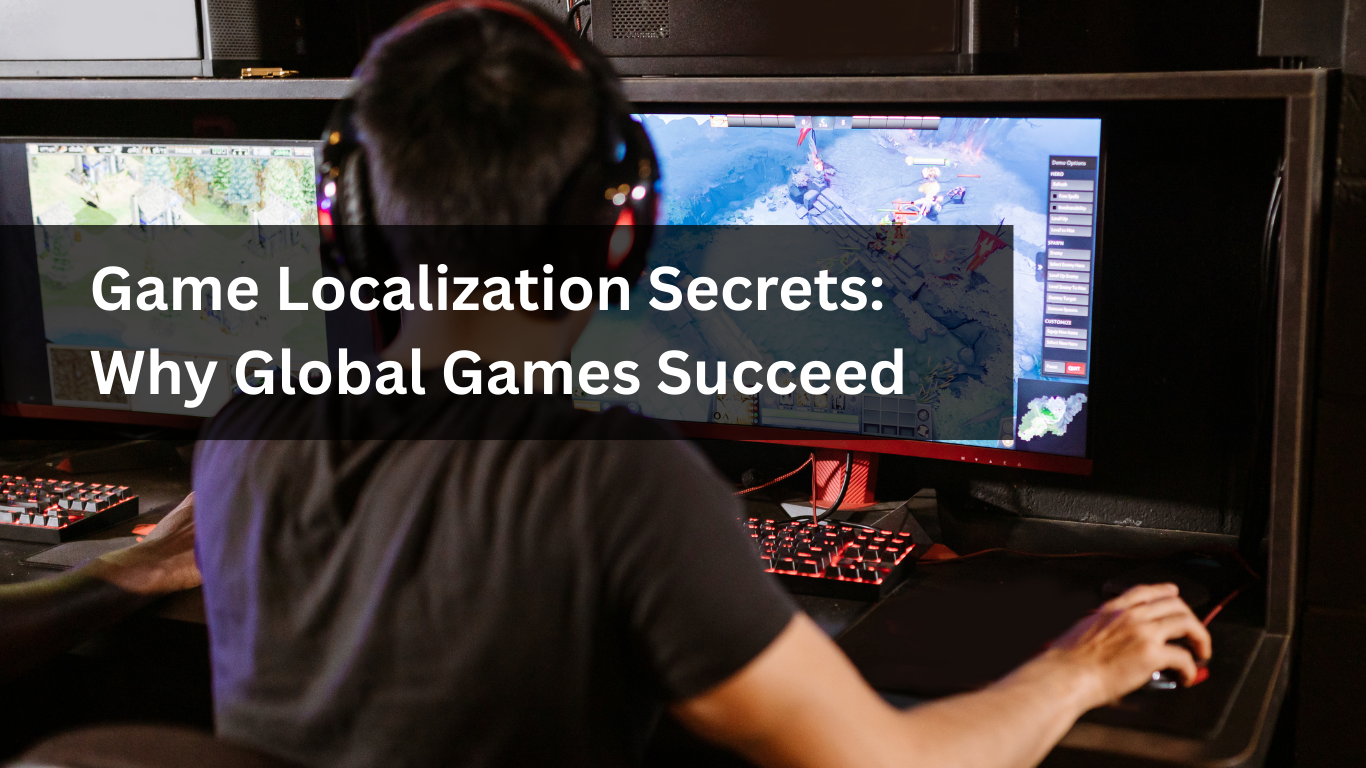
Game Localization Secrets: Why Global Games Succeed
(And How Quadrate’s Multilingual Business Localization Fix Everything)
Unlock Multilingual Communication with Accurate Localization & Translation Services
The gaming industry has never been bigger, louder, or more competitive. Every month, developers roll out brilliant titles boasting stunning graphics, cinematic-level soundtracks, ground-breaking mechanics, and worlds meticulously built over years. But despite all that effort, many of these games never find real global success.
They don’t fail because of gameplay.
They don’t fail because of weak marketing.
They don’t fail because players “didn’t get it.”
They fail because of a hidden, underestimated, often ignored monster:
Bad game localization.
In an industry where more than 70% of gaming revenue comes from non-English markets, localization determines whether your game becomes a global sensation or a forgettable title buried under Steam’s endless scroll.
This is the truth developers rarely admit but gamers experience all the time.
And it’s the reason game translation and localization have become the most powerful, ROI-positive weapons in modern gaming.
Let’s dive deep into the global storm changing gaming forever.

Gamers Don’t Hate Your Game — They Hate Your Translation
Gamers are extremely forgiving when it comes to bugs, difficulty spikes, or slow patches. But nothing destroys immersion faster than translation that feels like it escaped from a broken chatbot.
We’ve all seen it:
Dialogue that feels stiff, mechanical, or laughably inaccurate
Jokes that fall flat because the translator didn’t understand the reference
Lore texts that contradict quests
Tutorials that explain nothing and confuse everything
UI text that overflows, clips, or simply doesn’t fit
Story choices that lose emotional nuance when translated literally
When localization fails, the entire game collapses like a tower made of matchsticks.
Gamers quickly take screenshots, share them on Reddit, Discord, X, YouTube, and TikTok, and suddenly your studio becomes the community’s new comedic target.
It doesn’t matter if your game took five years to build.
It doesn’t matter if your team sacrificed weekends.
A single mistranslated line can become the joke people remember you for.
Localization determines whether players laugh with you or at you.
Translation Is Not Localization — And That Mistake Costs Millions
Developers who think “translation” and “localization” are the same thing are setting themselves up for disaster.
Translation = converting text
Localization = adapting worlds
Games depend on immersion, story, emotion, timing, pacing, humor, UI clarity, lore consistency, and cultural familiarity. You cannot translate those word-for-word. Doing so guarantees awkward phrasing, broken meaning, and emotionless storytelling.
Localization transforms everything:
Not just what characters say — but how they say it.
Including:
Dialogue tone
Emotional weight
Regional idioms
Character personality
Social norms
Sarcasm
Irony
Wordplay
Slang
Fight cries
Story pacing
Cultural nuance
Every line has purpose. Every word sits within a world.
Localization preserves that world so new audiences experience it as intended.


Global Markets Are No Longer Optional — They Are The Majority
More than 3.4 billion people play video games today.
Here’s where they live:
China — largest gaming population on the planet
Japan — home to demanding, story-driven gamers
South Korea — esports capital with massive loyalty
LATAM — social media hype + viral growth
Middle East — mobile-first gaming explosion
India — fastest-growing gaming market globally
Europe — deep RPG and strategy fanbase
If your game isn’t localized, you are effectively ignoring:
95% of Chinese players
90% of Japanese players
80% of Korean players
70% of Spanish-speaking players
65% of Portuguese players
60% of Arabs
Hundreds of millions of Indian-language speakers
Localization isn’t “good to have.”
It is the price of entry if you want global success.
The Cultural Missteps That Destroy Games Overnight
Here’s the uncomfortable truth:
Localization mistakes aren’t always linguistic.
Many are cultural.
Imagine this:
Your game releases in the Middle East but includes symbolism considered offensive
Your game launches in China with phrases that violate censorship guidelines
Your Japanese localization uses incorrect honorifics
Your Spanish version uses slang from Spain but launches in Mexico
Your Hindi version mixes Mumbai slang with Delhi dialect
Your Korean voiceover sounds flat and robotic, killing the drama
Even a well-translated sentence can be culturally wrong.
Localization teams must understand:
Cultural taboos
Color meanings
Religious sensitivities
Humor preferences
Regional dialects
Gender norms
Age rating laws
Historical references
Political sensitivities
Games are ecosystems. You can’t simply translate a tree and expect the forest to survive.


Voice Localization — The Secret Weapon That Players Instantly Feel
Voice acting can turn a character into a legend or a joke.
When a villain expresses rage with the energy of a bored accountant, players disconnect instantly.
When a comedic character sounds monotone or poorly timed, the entire identity collapses.
Voice localization requires:
Casting native voice actors
Lip-sync alignment
Timing and rhythm adaptation
Emotional direction
Performance matching
Character intent preservation
The same protagonist can sound heroic in Japanese, annoying in English, inspiring in Korean, and flat in Spanish — all because of localization choices.
Voice localization is where stories become alive.
The Real Work Behind Game Localization
Most players assume localization is just a translator staring at a spreadsheet. Actual localization looks like this:
1. Linguistic Translation
Baseline text conversion.
2. Narrative Localization
Rewriting dialogue to match tone, pacing, and character intent.
3. UI/UX Localization
Ensuring text fits buttons, menus, maps, inventory boxes, and HUDs.
4. Cultural Adaptation
Removing offensive references, updating jokes, adapting lore.
5. Subtitle Timing & Formatting
Line breaks, timing, spacing, readability.
6. Voiceover Localization
Recording multilingual voice lines, syncing them to animations.
7. Audio mixing & mastering
Matching original game audio levels and effects.
8. LQA (Localization Quality Assurance)
Testing in real playthroughs to:
Catch bugs | Verify consistency | Fix text overflow
Correct mistranslations | Ensure cultural accuracy
9. Regional Compliance
Meeting laws for China, Japan, Europe, Middle East, India.
10. Patch updates
Localizing future content, DLCs, expansions, and events.
Game localization is an entire production pipeline — not a translation job.


The Financial Reality —
Localization Increases Revenue by 300%
Here’s what studios see after proper localization:
✔ 200–300% more downloads
✔ Major increase in in-app purchases
✔ Higher Steam reviews and ratings
✔ Better App Store/Play Store rankings
✔ More influencer content
✔ Longer average playtime
✔ More active communities
✔ More fan art, memes, streams, and discussions
Localized games don’t just reach more players —
they convert more players.
This is why even indie studios now localize their games for:
Japanese | Korean | Mandarin | Arabic
Spanish (LATAM + Spain) | French | German
Portuguese | Russian | Hindi | Tamil
Telugu | Bengali | Marathi And more
The ROI is undeniable.
Genre-Specific Localization Challenges
Every genre has unique localization problems.
RPGs
Deep lore, complex systems, lengthy dialogue — localization can make or break immersion.
MMORPGs
Real-time chat, guild culture, skill descriptions, lore events — massive linguistic load.
Battle Royale / FPS
Clarity is everything. One mistranslated tip can ruin gameplay.
Strategy Games
Tons of terminology, resource systems, and historical references.
Adventure Games
Emotion-driven narratives require perfect tone matching.
Visual Novels
Localization must preserve romance, humor, and psychological nuance.
Casual & Hyper-casual
Small text changes make huge download differences.
Indie Games
Localization makes or breaks global visibility.
Each genre needs its own localization strategy.

The Studios That Win Are the Ones That Localize Smart
Great localization involves:
Native-speaking linguists
People who actually understand gamer culture.
Local QA testers
People who play games the way real audiences do.
Industry experts
People who understand lore design, story arcs, and scripting.
Technical experts
People who know how text interacts with UI/UX and game engines.
The winning formula is not “translate everything.”
Translate what matters. Localize what transforms. Adapt what connects.
Rewrite what improves. Remove what offends. Keep what defines the story.
Quadrate — The Localization Partner Built for Gaming
Quadrate brings together linguists, gamers, voice actors, cultural experts, UI designers, engineers, and QA testers to deliver end-to-end game localization that feels natural, immersive, and native to each region.
Our services include:
Game translation for 30+ languages
Full localization of stories, quests, lore, UI, and menus
Subtitle localization
Lip-sync and voiceover localization
Native voice actor casting
Cultural adaptation & compliance checks
Localization QA
Regional content approvals
App Store & Play Store localization
Ongoing localization for DLCs & updates
Supported languages:
Mandarin, Japanese, Korean, Arabic, Spanish, Portuguese, French, German, Russian, Hindi, Tamil, Telugu, Bengali, Marathi, Malayalam, Kannada, Urdu, and more.

The Games That Go Global Are the Ones That Learn to Speak
The global gaming community is diverse, multilingual, and culturally rich.
A great game is universal — but only if players can understand, feel, and connect with it.
Localization doesn’t dilute the game. It amplifies it. It helps your world reach new worlds. It helps players fall in love with the story you built. It transforms a regional release into a global franchise. If there’s one truth that defines modern gaming, it’s this: Games aren’t truly global until they speak the language of the players.
And the studios that master localization aren’t just releasing games. They’re building universes that anyone, anywhere, can live in.
Get Your Urgent Translation Now → [Upload Your File / Get a Quote]
Request a Free Quote Today | 24/7 Availability | Serving Pan-India & Worldwide Clients | Certified Translators & Localization Experts