
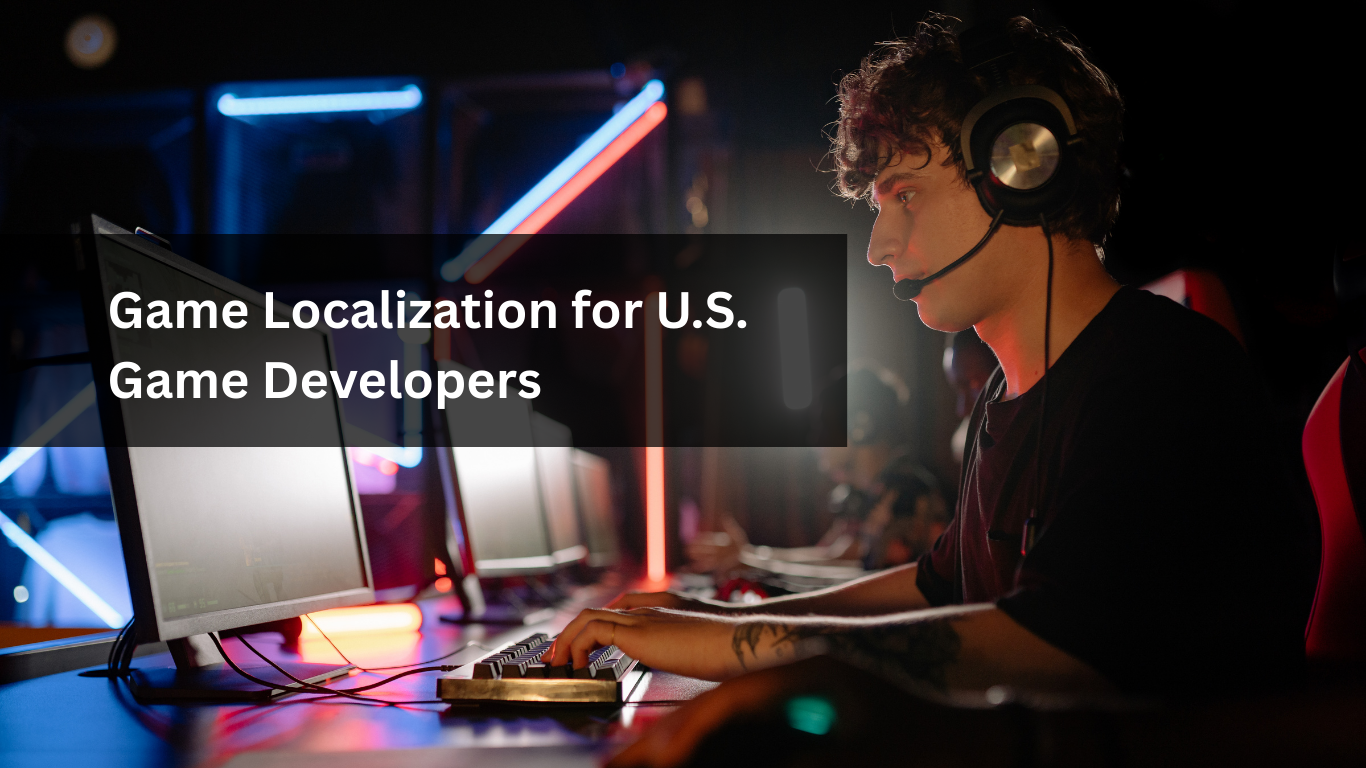
Game Localization for U.S. Game Developers: Spanish-to-English Strategies
Unlock Multilingual Communication with Accurate Localization & Translation Services
The Hidden Revenue Lever Most Studios Ignore
The U.S. gaming industry generates over $100 billion annually. It is the largest single-country market in the world. Meanwhile, more than 42 million people in the United States speak Spanish at home. That is not a niche. That is a mainstream audience.
Yet many U.S.-based studios still treat Spanish-to-English game translation as a reverse afterthought instead of a strategic growth lever.
Indie developers launch on Steam. Mid-sized studios push console titles. Mobile publishers scale globally. But when it comes to localization, the approach is often reactive.
In 2026, that is expensive.
Because localization is no longer just translation. It is cultural positioning, AI-assisted workflow orchestration, and cross-border collaboration. Studios that understand this gain measurable market advantage.
This guide breaks down how to approach Spanish-to-English game localization strategically, how AI in game localization is reshaping workflows, and how U.S. studios can collaborate with Indian localization vendors without compromising quality.
No fluff. Just systems that work.

What Is Game Localization?
Game localization is the adaptation of a video game for a specific linguistic and cultural market.
It goes beyond:
Text translation
UI string replacement
Subtitle conversion
True localization includes:
Dialogue adaptation
Cultural reference adjustment
Voice-over casting
UI/UX layout modification
Legal compliance adaptation
Store listing optimization
In-game monetization terminology
For U.S. game developers, Spanish-to-English game translation often appears redundant. After all, English is already the primary development language.
But many studios develop first in Spanish for Latin American markets or collaborate with Spanish-speaking writers, designers, and indie teams. Others acquire Spanish-language IP and repurpose it for the U.S. market.
In these cases, localization becomes revenue-critical.
Why Spanish-to-English Localization Matters for U.S. Developers ?
1. The U.S. Is Not Linguistically Homogeneous
62+ million Hispanics live in the U.S.
Spanish is the second-most spoken language nationwide
Bilingual households influence purchasing decisions
Even English-dominant Hispanic players respond differently to culturally aligned narratives.
Direct translation does not equal cultural resonance.
2. Hispanic Gamers Over-Index on Mobile and Console
Market data shows Hispanic gamers in the U.S.:
Spend more time on mobile gaming
Engage deeply with community-driven titles
Influence streaming and social sharing behavior
Localized messaging impacts retention and monetization.
3. IP Acquisition from Latin America Is Increasing
U.S. publishers are acquiring and adapting:
Indie Spanish-language RPGs
Narrative-driven mobile titles
Esports-focused competitive games
Spanish to English game translation must preserve original identity while aligning with U.S. audience expectations.
This is strategic repositioning, not mechanical conversion.


Cultural Adaptation for American Players
Translation changes words. Localization changes experience.
Humor
Spanish humor may rely on:
Regional idioms
Wordplay
Cultural stereotypes
These often collapse in direct translation.
U.S. humor preferences vary by:
Region
Age demographic
Platform culture
A joke that works in Mexico City may fail in Chicago.
Tone and Directness
Spanish dialogue can feel more emotionally expressive. American English in gaming often trends toward concise, direct phrasing.
Example:
Spanish original:
“¡Vamos! ¡No podemos rendirnos ahora!”
Literal translation:
“Come on! We cannot give up now!”
Localized adaptation:
“Move. We’re not done.”
Same meaning. Different pacing. Stronger impact for U.S. players.
Regulatory and Content Sensitivity
U.S. markets require alignment with:
ESRB standards
Platform compliance (Sony, Microsoft, Nintendo)
FTC advertising guidelines
Cultural adaptation includes compliance language in:
In-game disclaimers
Loot box probability disclosures
Privacy policies
Ignoring this creates legal exposure.
Common Localization Mistakes
Studios repeat these errors constantly.
1. Translating Without Context
Developers export CSV files full of string IDs:
BTN_045_CONFIRM_ACTION
Translators guess.
Result:
UI breaks. Tone shifts. Player immersion suffers.
2. Ignoring Character Limits
English text can be shorter or longer than Spanish. UI overflow causes:
Broken buttons
Cropped subtitles
Overlapping HUD elements
Localization must be tested in-engine.
3. No Glossary or Style Guide
Without:
Terminology database
Tone guidelines
Character profiles
Consistency collapses across expansions and updates.
4. Late-Stage Localization
When localization happens after code freeze:
Bugs increase
QA timelines shrink
Costs spike
Localization must begin during pre-production.


Role of AI & LLMs in Game Localization
AI in game localization is no longer experimental. It is operational. Large Language Models (LLMs in game development) assist with:
First-pass translation
Terminology extraction
Sentiment alignment
Dialogue tone rewriting
Automated QA checks
But AI is not a replacement for human localization. It is a workflow accelerator.
Practical AI Workflow Example
- Export source strings.
- Run AI-assisted translation using custom prompt templates.
- Apply translation memory alignment.
- Human linguist reviews for tone and cultural nuance.
- In-engine testing.
- AI-driven QA scans for inconsistencies.
- Time reduction: 30 to 50 percent.
Quality improvement: depends entirely on human oversight.
Studios that treat AI as autonomous output generators fail. Studios that treat AI as a collaborative layer win.
USA vs India Cost & Workflow Analysis
Now we discuss what decision-makers care about: cost, scalability, reliability.
U.S.-Based Localization Vendors
Average cost:
$0.15 to $0.28 per word (Spanish to English game translation)
Pros:
Native cultural alignment
Direct time-zone collaboration
Regulatory familiarity
Cons:
Higher cost
Limited scalability for massive updates
Game Translation Companies in India
Average cost:
$0.06 to $0.12 per word
India’s localization outsourcing market has grown rapidly due to:
Large bilingual workforce
Technical gaming familiarity
Established BPO infrastructure
Pros:
Cost efficiency
24-hour workflow cycles
Strong QA scalability
Cons:
Requires strong vendor management
Cultural nuance must be validated
Hybrid USA–India Workflow Model
Best-performing studios often use:
AI-assisted pre-translation
Indian linguists for structured review
U.S.-based editors for cultural refinement
This reduces cost by 35 to 50 percent while preserving U.S. audience resonance.
Time-zone difference becomes an advantage when managed correctly.


Best Practices Checklist
For U.S. game developers implementing Spanish-to-English localization:
Begin localization during pre-production
Build a glossary before translation begins
Use AI only as first-pass support
Maintain centralized translation memory
Conduct in-engine linguistic QA
Use bilingual U.S. beta testers
Monitor player reviews for localization feedback
Update localization assets continuously
Localization is iterative, not one-time.
Future of AI in Game Localization
AI will soon:
Adapt NPC dialogue dynamically
Modify tone based on player region
Predict culturally sensitive phrasing
Automate live-service patch localization
However:
Fully autonomous localization will remain risky for narrative-heavy titles.
The real evolution is AI-enhanced human creativity.
Studios that invest in:
Structured localization pipelines
Vendor collaboration frameworks
Prompt engineering standards
Will dominate cross-market scaling.

Frequently Asked Questions
1. What is game localization for U.S. game developers?
Game localization for U.S. game developers is the process of adapting game content linguistically and culturally to resonate with American players while ensuring regulatory compliance and platform alignment.
2. Is game translation different from normal translation?
Spanish to English game translation requires tone adaptation, cultural reference adjustment, UI modification, and contextual rewriting rather than literal word replacement.
3. Can AI fully replace human game localization?
AI can accelerate translation workflows but cannot fully replace human linguists for dialogue, humor, and cultural nuance.
4. Is outsourcing to India safe for game localization?
Yes, when structured properly. Many game translation companies in India offer cost-effective services, but U.S. cultural review layers are recommended.
5. How much does video game localization cost in the USA?
Costs range from $0.15 to $0.28 per word in the USA, while Indian vendors typically range from $0.06 to $0.12 per word depending on complexity.
Conclusion
Localization Is Competitive Infrastructure, Not an Afterthought
Game localization for U.S. game developers is no longer just a translation step at the end of production. It is a strategic growth engine that directly influences retention, reviews, monetization, and long-term brand positioning. Spanish-to-English game translation, when executed with cultural precision and supported by AI-assisted workflows, allows studios to expand confidently into the U.S. market while preserving narrative integrity.
The most successful publishers are adopting hybrid models that combine AI efficiency, Indian localization scalability, and U.S.-based cultural refinement to balance cost and quality. In a market as competitive as the United States, localization is not a post-launch fix. It is infrastructure. Studios that design structured, intelligent localization pipelines early will scale faster, launch stronger, and compete more effectively in the age of AI-driven game development
Request a quote. Submit documents securely. Get it right the first time.
Get Your Urgent Translation Now → [Upload Your File / Get a Quote]
Request a Free Quote Today | 24/7 Availability | Serving Pan-India & Worldwide Clients | Certified Translators & Localization Experts