
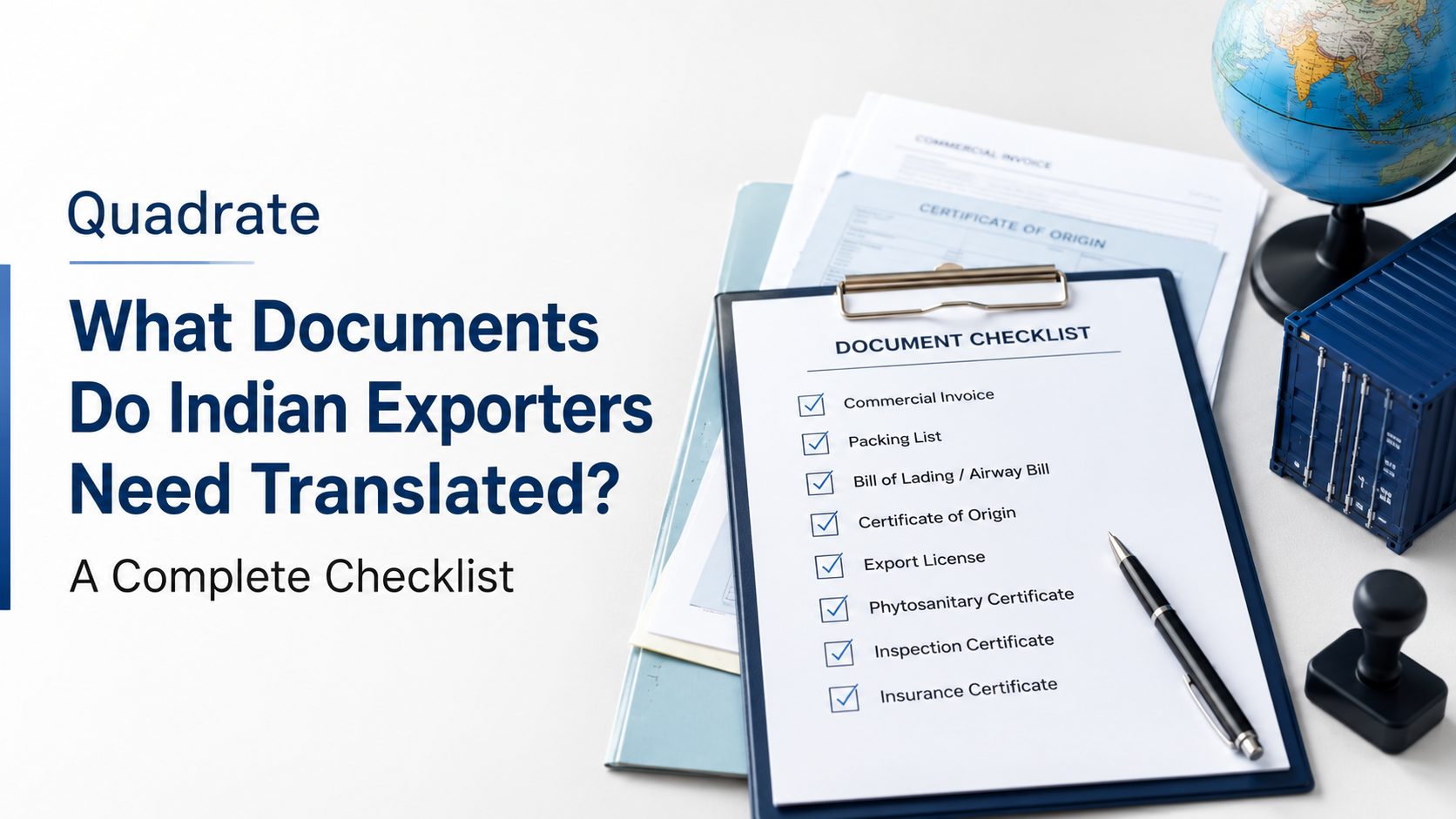
What Documents Do Indian Exporters Need Translated? A Complete Checklist
Quick answer: Indian exporters typically need to translate commercial documents (invoices, packing lists, purchase orders), regulatory and compliance documents (certificates of origin, safety data sheets, product certifications), technical documentation (user manuals, datasheets, labels), and legal documents (contracts, letters of credit). The exact requirements depend on the destination country and product category — the EU, Gulf, and East Asian markets each impose different language rules.
Every Indian exporter eventually hits the same wall: the product is ready, the buyer is ready, and then a customs officer, a distributor, or a regulator asks for documentation in a language the paperwork isn’t in. A single untranslated or badly translated document can hold a shipment at the border, delay payment, or fail a compliance check.
This checklist breaks down exactly which documents Indian exporters need translated, organised by category, along with the languages different markets expect. Use it to audit your own export paperwork before it becomes a problem at the port.
Why do export documents need professional translation?
Export documents need professional translation because they carry legal, financial, and safety weight — and because most destination countries legally require certain documents in their official language. A mistranslated figure on a commercial invoice can trigger a customs dispute; an inaccurate safety instruction can breach regulations and create liability; an ambiguous contract clause can cost you a payment. Machine translation and in-house guesswork routinely fail on exactly the terminology — HS codes, chemical names, technical specifications, legal phrasing — where errors are most expensive.
The rule of thumb: if a document is read by a customs authority, a regulator, a court, or an end user in another country, it needs professional, often certified, translation.
1. Commercial and shipping documents translation
These move with every shipment and are the first thing customs inspects:
- Commercial invoice — the core customs document; must match the buyer’s language for clearance in many markets
- Packing list — contents, weights, and dimensions
- Purchase orders and proforma invoices
- Bill of lading / airway bill
- Letter of credit documentation — banks reject documents with discrepancies, so translation accuracy directly affects whether you get paid
- Shipping instructions and delivery notes
Errors here don’t just delay goods — they delay payment, because letter-of-credit terms are enforced literally.


2. Regulatory and compliance documents Translation
This is where most exporters get caught, because requirements are country-specific and legally mandated:
- Certificate of origin
- Safety Data Sheets (SDS/MSDS) — legally required in the destination language under GHS and REACH in the EU; non-negotiable for chemicals, coatings, and many industrial goods
- Product certifications (CE, BIS, ISO conformity documents)
- Import/export licenses and permits
- Phytosanitary and health certificates (agri, food, pharma)
- Customs declarations
Many countries will not clear goods until this documentation exists in their official language. For exporters shipping to the EU, this often means translation into the specific member-state language — German for Germany, French for France, and so on.
3. Technical documentation Translation
Anything the end user or a technician reads:
- User and operator manuals
- Installation and maintenance guides
- Product datasheets and specifications
- Packaging and labelling text — often legally required in the local language, with specific rules on what must appear
- Warning labels and safety instructions
- Assembly instructions
For manufacturers and machinery exporters, this is high-stakes: a mistranslated safety warning or assembly step isn’t a typo, it’s a liability and potentially a recall. This is also where layout matters — diagrams, callouts, and multilingual desktop publishing have to survive the translation intact.
4. Legal and contractual documents Translation
Where a single clause carries real consequence:
- Sales and distribution contracts
- Agency and partnership agreements
- Non-disclosure agreements
- Terms and conditions / warranties
- Patents and IP documentation
- Regulatory compliance filings
These need certified legal translation by linguists with domain expertise — not general translators — because a mistranslated indemnity, jurisdiction, or payment clause can invalidate the agreement or shift liability onto you.
5. Marketing and product content Translation
Not legally required, but decisive for actually selling:
- Product catalogues and brochures
- Website and e-commerce listings
- Marketing and campaign material
This is localization, not just translation — content adapted for the target culture so it persuades rather than merely informs.
Which languages do Indian exporters need most?
The destination market decides the language:
- European Union: German, French, Italian, Spanish, Dutch, Portuguese — and the EU frequently requires documentation in the specific member state’s language, not just English
- Middle East / Gulf: Arabic — mandatory for labelling and much official documentation
- East Asia: Japanese, Korean, Mandarin (Simplified & Traditional)
- Africa & Francophone markets: French, Portuguese
- Within India (for inbound/JV documentation): Hindi and regional languages

A note for
Tamil Nadu and South India exporters who needs translation
Tamil Nadu is one of India’s largest export bases — knitwear from Tiruppur, automotive components from the Chennai–Hosur belt, machinery, leather, and chemicals. Exporters here face the full range of requirements above, often into EU and Gulf markets simultaneously. The recurring gap we see is documentation translated too late in the process, after an order is already placed, which creates avoidable delays at exactly the wrong moment.
The exporter’s translation checklist (quick reference)
Before your next shipment, confirm you have translated, where required:
☐ Commercial invoice
☐ Packing list
☐ Certificate of origin
☐ Safety Data Sheets (if applicable)
☐ Product certifications (CE/BIS/ISO)
☐ User manuals and installation guides
☐ Packaging and labelling
☐ Warning and safety labels
☐ Contracts and agreements
☐ Letter of credit documentation
Get your export documents translated right the first time
Quadrate is an ISO 17100-certified translation company working with exporters and manufacturers across India in 100+ languages — commercial, regulatory, technical, and legal documentation handled by native subject-matter linguists with human quality assurance. Send us your document set and target markets, and we’ll tell you exactly what needs translating and into which languages.


FAQ – Documents That Requires Translation
1. Which export documents legally require translation?
Requirements vary by country, but safety data sheets, product certifications, labelling, and often commercial invoices must be in the destination country’s official language. The EU, Gulf states, and East Asian markets each have specific mandates.
2. Do export documents need certified translation?
Regulatory, legal, and customs documents usually require certified translation to be accepted by authorities, banks, and courts. Marketing and internal documents generally do not.
3. Can I use machine translation for export documents?
Machine translation is risky for export documentation because errors in HS codes, chemical names, technical specifications, and legal clauses can cause customs delays, rejected payments, or compliance failures. Certified human translation is the standard for official documents.
4. What languages do Indian exporters translate into most?
German, French, Spanish, Italian, and Dutch for the EU; Arabic for the Gulf; Japanese, Korean, and Mandarin for East Asia — depending on the destination market and product category.
5. How long does export document translation take?
Turnaround depends on volume, language, and certification requirements. Standard document sets are typically completed within a few business days, with expedited options for urgent shipments.