
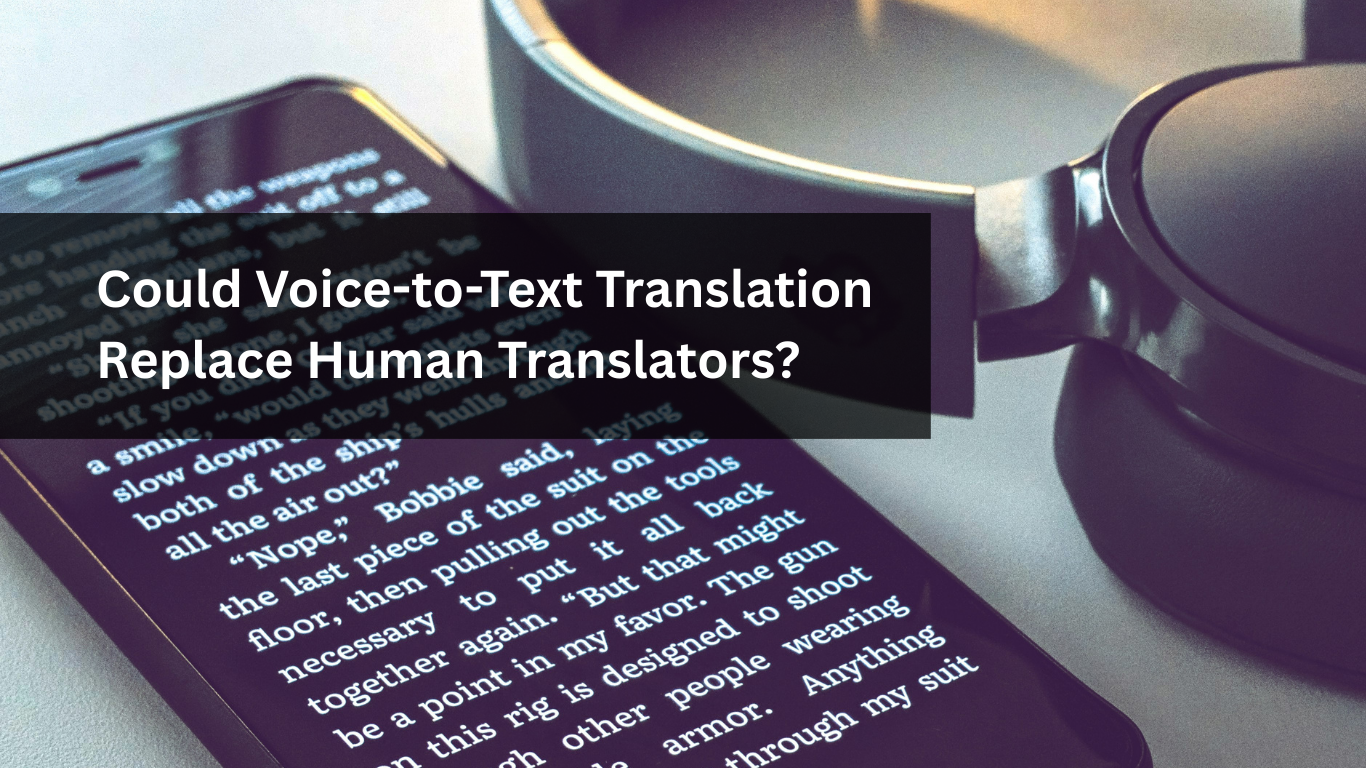
Could Voice-to-Text Translation Be the Death of Traditional Translation?
Unlock Multilingual Communication with Accurate Translation Services
Introduction
Technology is transforming the way humans communicate. What once took days or even weeks of manual translation can now happen in seconds thanks to voice-to-text translation apps, AI-powered speech recognition, and advanced machine learning algorithms.
But this rapid innovation raises a crucial question: Will traditional human translators become obsolete?
In this blog, we’ll explore how voice-to-text translation is shaping the future of multilingual communication, its advantages, limitations, and whether it poses a real threat to professional translators.


What Is Voice-to-Text Translation?
Voice-to-text translation is the process of converting spoken language into written text and instantly translating it into another language.
Examples of Voice-to-Text Tools:
Google Translate voice feature – supports real-time translations in over 100 languages.
Microsoft Translator – integrates with Microsoft Office and Teams for live translation.
AI-driven tools like DeepL with speech modules – optimized for professional and technical translations.
Real-time translation earbuds – such as Google Pixel Buds and Timekettle earbuds.
This technology relies on speech recognition, natural language processing (NLP), and machine learning, allowing near-instant translations in dozens of languages.
Why Voice-to-Text Translation Is Gaining Popularity
1. Speed & Convenience
A spoken phrase can be translated in real time. For travelers, business meetings, or global customer support teams, this is a game-changer.
2. Affordability
Most apps are either free or low-cost, making voice-to-text translation far cheaper than hiring a professional translator.
3. Accessibility
From students in Mumbai to entrepreneurs in New York, anyone with a smartphone can access multilingual communication tools instantly.
4. Integration with Daily Life
Voice-to-text translation is being embedded into:
Smartphones
Wearable devices
Cars
Virtual assistants like Alexa and Siri
This level of integration makes multilingual communication effortless for everyday users.

The Advantages of
Voice-to-Text Over Traditional Translation
Voice-to-text translation comes with several unique advantages:
Instant Output: Translations happen in seconds with zero turnaround time.
Scalability: Works across multiple languages simultaneously.
Always Available: No need to schedule a translator.
Affordable: Basic translation often comes at no cost.
Case Example:
An e-commerce business in Mumbai used voice-to-text translation software to quickly localize product descriptions into Hindi and Marathi. They cut translation costs by 40% while still maintaining readability for local audiences.
The Limitations of Voice-to-Text Translation
Despite its benefits, voice-to-text translation has significant limitations.
1. Lack of Context
Machines often struggle with idioms, humor, sarcasm, and cultural nuance.
Example: The phrase “Break a leg” could be translated literally instead of meaning “Good luck”.
2. Accuracy Issues
Background noise, diverse accents, and fast speech often reduce the accuracy of translations, making them unreliable in critical situations.
3. Limited Industry Usage
Industries such as legal, medical, and technical translation demand 100% precision, which AI still cannot consistently provide.
4. No Confidentiality Guarantee
Most voice-to-text platforms store data on third-party servers, raising security and privacy concerns for sensitive documents.


Where Human Translators Still Dominate
Even in an AI-driven world, human translators excel in areas requiring nuance, creativity, and cultural sensitivity:
Legal Translation
Courts, immigration, and contracts require certified human translation for enforceability and legal accuracy.
Medical Translation
Patient records, research papers, and drug labels cannot risk errors. AI translations may misinterpret critical information.
Creative Industries
Literature, film subtitles, and marketing copy need cultural adaptation, tone, and style, which machines cannot replicate.
High-Stakes Business
Investor pitches, mergers, and global negotiations demand a human understanding of tone, strategy, and cultural context.
Could Voice-to-Text Translation
Replace Human Translators?
The honest answer: Not entirely.
For casual use, travel, or basic communication, voice-to-text tools may reduce the need for human translators.
For critical industries like law, medicine, finance, or creative content, human translators remain indispensable.
The most likely scenario is a hybrid model:
AI for speed and scale
Human review for accuracy and cultural nuance
This combination provides the best of both worlds.


FAQs About Voice-to-Text Translation
Q1. Is voice-to-text translation accurate enough for legal use?
No. Courts, embassies, and official bodies require certified human translations.
Q2. Will voice-to-text translation apps replace translators?
They may replace translators in casual contexts, but human expertise remains irreplaceable in professional and high-stakes situations.
Q3. Which industries can safely use voice-to-text translation?
Travel, tourism, casual communication, and basic business meetings.
Q4. Can voice-to-text translation handle multiple accents?
Yes, but accuracy declines significantly with heavy accents or noisy environments.
Q5. What’s the future of multilingual communication?
A hybrid model: AI-powered translation for speed + human translators for reliability.
Conclusion: Threat or Opportunity?
So, could voice-to-text translation be the death of traditional translation?
Not quite. While AI is reshaping the translation industry, it cannot replace the creativity, cultural knowledge, and precision of human translators.
Professional translators should embrace AI as a tool for efficiency, positioning themselves as trusted quality gatekeepers.
Voice-to-text translation is not the death of traditional translation – it is the evolution of it.
Ready to translate the right way? Let’s talk.
Explore Translation Services at Quadrate | Get a Free Translation Quote | Linked In