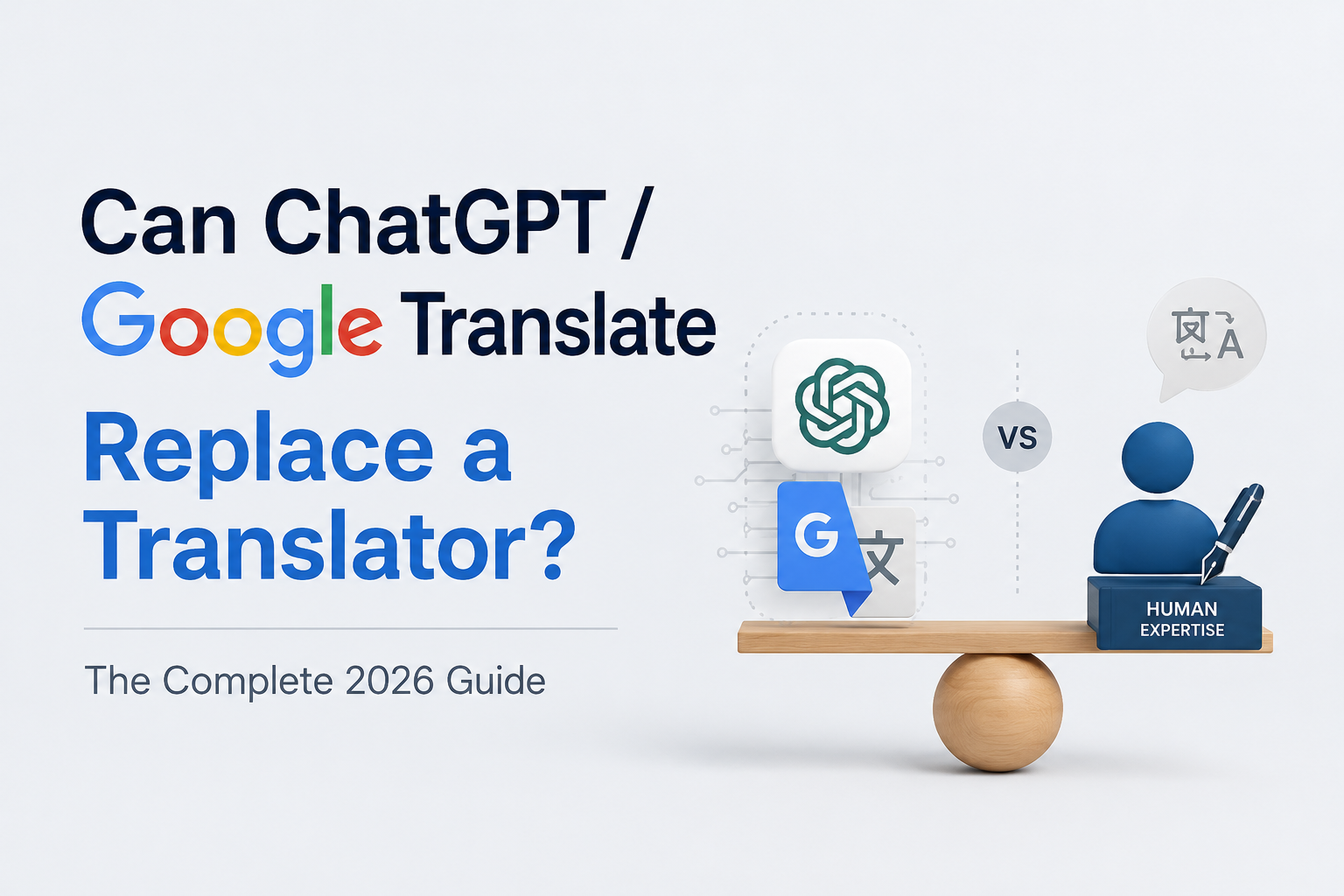
Can I Just Use ChatGPT or Google Translate Instead of Hiring a Translator? The Complete Guide
If you’ve typed some version of this question into Google, you’re not alone. It’s one of the most common questions businesses, students, freelancers, and everyday people are asking right now, as AI tools get fluent enough to feel like they’ve solved translation entirely.
They haven’t. Not because the technology isn’t impressive — it is — but because “fluent” and “correct” are two different things, and the gap between them is exactly where expensive mistakes happen.
This guide answers every version of this question we consistently see people ask: about accuracy, legal risk, cost, certification, website localization, video and subtitles, data privacy, and what to actually do with this information. No fluff, no sales pitch dressed up as advice — just a straight answer to each question, backed by how this actually plays out in real translation projects.
Table of Contents
- What’s actually happening when ChatGPT or Google Translate “translates” something
- How accurate is AI translation in 2026, really?
- Will AI replace human translators?
- Is machine translation accurate enough for legal documents?
- Is machine translation safe for medical and healthcare content?
- Can an AI-translated document be certified or notarized?
- ChatGPT vs Google Translate vs DeepL — which is actually best?
- What is MTPE (machine translation post-editing) and should you use it?
- Can I use AI to localize my website or marketing content?
- What about AI dubbing and subtitle translation?
- Is it safe to paste confidential documents into free AI tools?
- Cost comparison: AI vs. human vs. hybrid workflows
- A real example of where AI alone would have failed
- A decision framework: which option is right for your project?
- Where this is all heading
- Frequently asked questions

What’s Actually Happening When ChatGPT or Google
Translate “Translates” Something ?
It helps to understand what these tools are actually doing under the hood, because it explains everything else in this article.
ChatGPT, Google Translate, and DeepL are not “reading” your text and understanding its meaning the way a human translator does. They’re predicting the most statistically likely sequence of words in the target language, based on patterns learned from enormous amounts of training data. Modern neural machine translation (NMT) and large language models have gotten remarkably good at this — good enough that casual users often can’t spot anything wrong.
But prediction isn’t comprehension. These systems don’t know why a phrase means what it means, whether a term has a different legal definition in your target jurisdiction, or whether your brand would never use that particular tone in French. They’re producing the output that statistically resembles a correct translation — which is usually right, and occasionally wrong in ways that are very hard to catch unless you already know the target language well.
This is the single most important thing to understand before deciding whether to skip a human translator: the failure mode isn’t “obviously broken text.” It’s fluent, confident, publishable-looking text that’s quietly incorrect.
How Accurate Is AI Translation in 2026, Really?
Short version: very accurate for general, low-complexity content. Meaningfully less reliable the moment you introduce legal terminology, technical jargon, ambiguity, humor, or cultural nuance.
Machine translation has matured into something close to an enterprise backbone for high-volume, everyday content — models trained on huge, domain-specific datasets now perform well enough to be used directly in customer support, e-commerce, and internal communications workflows. Quality Estimation (QE) systems can even predict, segment by segment, where a translation is likely to contain an error and route only the risky parts to a human reviewer, while letting the confident, low-risk segments pass straight through.
That’s genuinely impressive progress. But it comes with an important asterisk: fluency has been improving faster than accuracy. Industry analysis puts machine translation fluency gains at roughly 40% since 2023 — while true accuracy on complex text hasn’t kept pace at the same rate. That mismatch is why AI output can sound completely natural while still containing a wrong number, a flipped meaning, or a misapplied term — a hallucination that reads as confidently as the correct answer would have.
Where accuracy holds up well:
- Straightforward, single-meaning sentences
- Common language pairs with lots of training data (e.g., English–Spanish, English–French)
- Repetitive or formulaic content (product descriptions, FAQs, simple instructions)
Where accuracy drops noticeably:
- Legal, medical, financial, and technical terminology
- Idioms, humor, and culturally specific references
- Long, complex sentence structures with multiple clauses
- Low-resource language pairs with less training data
- Anything requiring the translator to know context outside the text itself
Will AI Replace Human Translators?
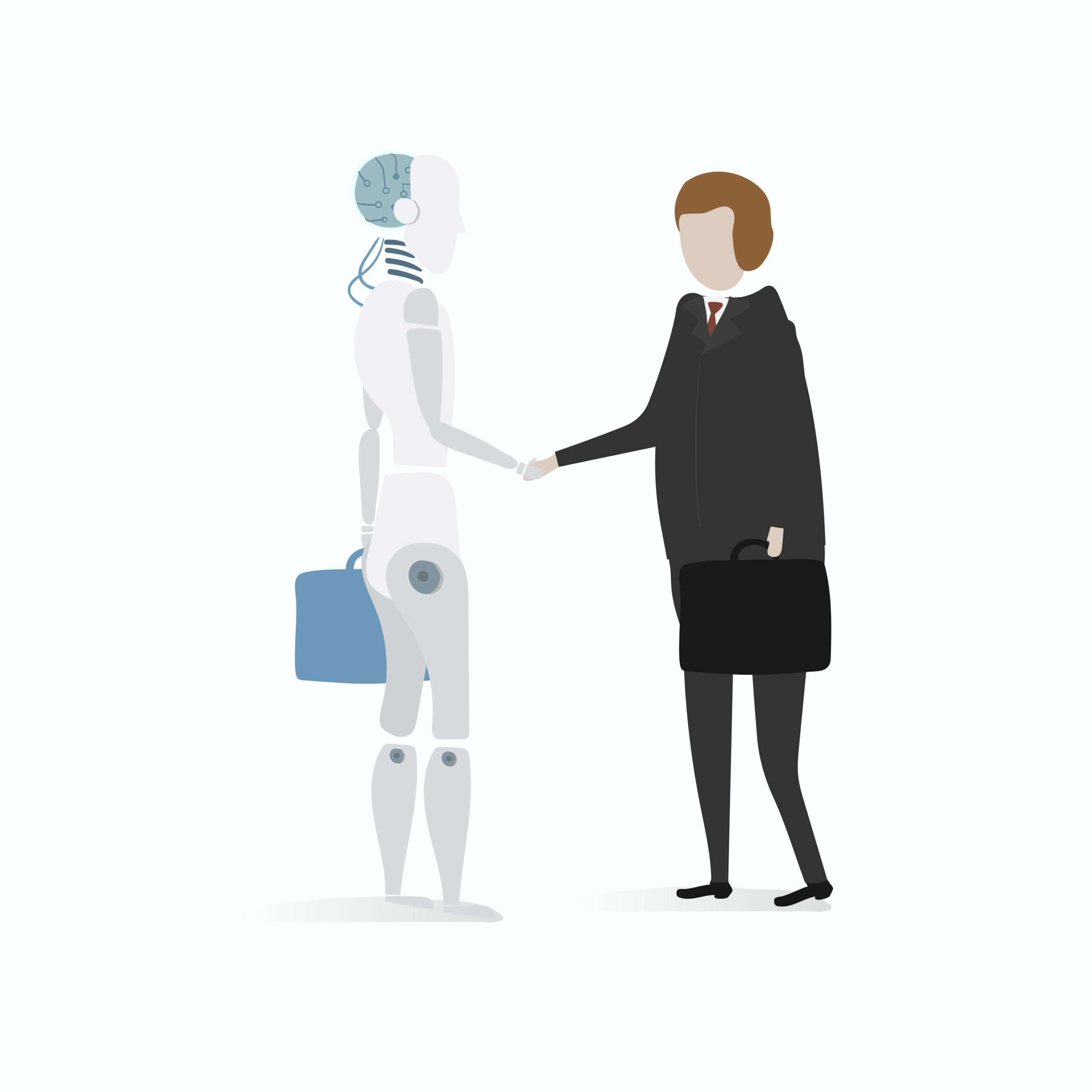
This is probably the single most-asked question in the industry right now, and the honest answer that keeps showing up across professional sources is consistent: AI will absorb more of the work, but not the role — at least not any time soon.
What’s actually happening is a shift in what translators spend their time on, not their disappearance. Clients increasingly ask “can’t I just run this through Google Translate?”, and yes — for low-stakes, high-volume, budget-driven content, some of that work genuinely is shifting to automation. But the deeper, harder work — capturing tone, subtext, humor, and cultural meaning — is exactly where AI still struggles, and that’s becoming the actual value a human translator provides.
The clearest way to think about it: AI translates words. A human translator translates meaning. Translators who adapt are moving into roles like AI-output reviewer, localization strategist, and quality supervisor — evaluating patterns of AI error at a systemic level rather than manually translating from scratch — while base-level, low-risk translation work becomes increasingly automated.
So if you’re asking this question because you’re worried about hiring a translator being “obsolete” — it isn’t. If you’re asking because you’re wondering whether you can skip one entirely for your project — that depends entirely on the stakes involved, which is the theme running through every section below.
Is Machine Translation Accurate for Legal Documents?
No — not on its own, and this is one of the clearest, most consistent answers across the entire industry.
Legal language is dense, jurisdiction-specific, and often built on concepts that don’t have a direct equivalent in another legal system. A word like “consideration” in contract law isn’t about thoughtfulness — it’s a specific legal concept, and machine translation tools routinely translate legal terms literally because they lack legal reasoning, not just language skill.
The risks aren’t theoretical. Courts in jurisdictions including Germany, France, and Argentina can reject machine-translated documents outright unless they’re certified by a recognized provider, and industries like pharmaceuticals, finance, and data protection can face regulatory non-compliance, audits, or fines if a machine-generated translation misses required legal precision. A single mistranslated clause in a cross-border contract has been known to trigger litigation costs well into the millions.
There is a middle ground, though, and it’s becoming standard practice: AI can produce a strong first draft — legal-domain-tuned AI tools have been shown to be around 30% more accurate than general-purpose machine translation, cutting context-dependent errors in legal documents by roughly 45% and ambiguity-related contract errors by about 50%. But even with those gains, the responsible use case is AI-assisted drafting followed by a qualified human legal translator’s review — not a fully automated pipeline for anything that will be signed, filed, or submitted.
Is Machine Translation Safe for Medical and Healthcare ?
The same logic applies here, arguably with even higher stakes. Medical translation carries the same fundamental risk as legal translation — dense, specialized terminology where a small error changes meaning in a way that can cause real harm (a swapped dosage unit, an inverted “not,” a misread symptom description).
This is precisely the failure mode that AI systems are prone to: they can confidently swap a “milligram” for a “microgram,” or reverse a negative, without any visible sign that something went wrong. That’s not a hypothetical edge case — it’s one of the most-cited concrete risks of relying on AI translation for anything safety-critical. For patient-facing materials, informed consent documents, clinical trial content, or regulatory submissions, human review by a subject-matter-qualified translator isn’t optional — it’s the only way to catch errors that look completely normal on the page.
Can an AI-Translated Document Be Certified or Notarized?
No. This is a clear, unambiguous line, and it’s worth understanding exactly why.
Certification isn’t just a quality claim — it’s a legal statement of accountability. A certified translation includes a formal declaration that the translation is complete and accurate, signed by a translator or agency willing to take legal responsibility if it isn’t. AI has no legal identity and cannot be held accountable, which means a document produced through a fully AI-driven workflow, with no professional human involved, generally cannot be certified for legal proceedings, immigration filings, or official government use — no matter how accurate it happens to be.
Courts, embassies, and government agencies specifically require an official seal, a translator’s signed declaration, and traceable accountability — none of which a machine can provide on its own. In the U.S., immigration courts and federal agencies require certified translations for documents like birth certificates and affidavits; the same requirement applies across the UK, Canada, and the EU. Using an AI-generated translation for these purposes typically results in delays or outright rejection, not a cost saving.
The workaround most legal and certified-translation providers use today is a hybrid model: AI produces a draft, an AI-assisted second pass improves consistency and terminology, and then a qualified human translator reviews the final version and signs the formal certification — meaning the human, not the AI, is the one legally vouching for the document.

ChatGPT vs. Google Translate vs. DeepL
Which Is Actually Best?
People ask this constantly, and the honest answer is: it depends what you’re using it for. Here’s how they actually differ in practice.
| Topics | Google Translate | DeepL | ChatGPT |
| Strength | Broadest language coverage, fast, good for quick gisting | Often more natural-sounding phrasing for European languages | Best at adjusting tone, formality, and style on request |
| Weakness | Can feel stiff or overly literal on nuanced text | Narrower language coverage than Google | Can “hallucinate” confidently — invents plausible-sounding but wrong content |
| Best use case | Quick understanding of foreign text, casual use | Business or marketing text where natural phrasing matters | Content needing style/tone adjustment, first-draft creative or marketing copy |
| Confidentiality | Free tier processes data on external servers | Free tier processes data on external servers | Free tier processes data on external servers; paid/enterprise tiers offer more control |
What Is MTPE (Machine Translation Post-Editing)
and Should You Use It?
MTPE is quietly becoming the real answer to “AI or human” for most growing businesses, and it’s worth understanding properly because it’s likely what you actually want.
Here’s how it works: instead of a human translator starting from a blank page, or a client publishing raw AI output, an AI engine produces the first full draft, and a professional linguist reviews, corrects, and refines it to human-quality standards before it’s delivered. This is often described as human-AI symbiosis — AI handles the heavy lifting of volume and speed, while the human provides the context, cultural judgment, and accountability that AI can’t reliably supply on its own.
MTPE has become the most common pricing and delivery model in professional translation today, precisely because it captures most of AI’s speed and cost advantage without accepting its accuracy risk. There are typically two tiers:
- Light post-editing — the reviewer fixes only critical errors (meaning, accuracy, omissions), leaving stylistic phrasing largely as the AI produced it. Faster and cheaper, appropriate for internal or lower-visibility content.
- Full post-editing — the reviewer brings the translation fully up to publication-ready human quality, matching what a translation-from-scratch would deliver, including tone, terminology, and cultural fit.
For most businesses wondering “can I skip a human translator entirely?”, the more useful question is usually “should I use full human translation or MTPE?” — because pure, unreviewed AI output is rarely the responsible choice once content leaves your internal team.
Can I Use AI to Localize My Website or Marketing Content?
This is a different question from document translation, and the answer is a more careful “partially, with caveats.”
For high-volume, low-visibility pages — internal knowledge bases, product spec sheets, FAQ pages — AI-driven translation, ideally with light human review, is often perfectly adequate and is exactly where the industry is investing most in workflow automation.
For anything that represents your brand voice — homepage copy, ad campaigns, taglines, product marketing — raw AI translation is genuinely risky, for a reason specific to marketing: transcreation. Marketing content often needs to be reimagined rather than literally translated, preserving the emotional intent and cultural resonance of the original rather than its literal words, and this is precisely the skill machine translation is weakest at. A tagline that’s clever in English can land flat, confusing, or accidentally offensive translated word-for-word — and AI won’t flag that risk because grammatically, the sentence is fine.
There’s also a newer, less obvious factor worth knowing about if SEO matters to you: visibility in AI-powered search and generated answers increasingly depends on whether your localized content aligns with how machine models understand relevance and quality in each target language — meaning weak, literal machine-translated content can quietly hurt your visibility in AI-driven search results, not just human readers’ perception of your brand.
+91 96000 44222

Is It Safe to Paste Confidential Documents Into Free AI Tools?
This question doesn’t get asked as often as it should, and it deserves a direct answer: be cautious. Free, consumer-facing AI translation tools frequently process and store the text you submit on external servers, which raises real concerns if you’re pasting in client contracts, unpublished financial data, personal information, or any proprietary content.
This isn’t a reason to avoid AI tools altogether — enterprise and paid-tier versions of these tools generally offer stronger data-handling guarantees, and many professional translation providers now use secure, private, on-premise AI models specifically to avoid this exposure. But if you’re using the free, public version of ChatGPT, Google Translate, or DeepL for anything containing sensitive information, it’s worth checking what that tool’s data policy actually says before you paste it in — most people never do.
Cost Comparison:
AI vs. Human vs. Hybrid Workflows
Pricing in translation is shaped by language pair, content complexity, and turnaround time — and AI has genuinely reshaped the cost structure of the industry, but not by eliminating human involvement; it’s shifted the most common pricing model toward MTPE.
The instinct to go with whatever’s cheapest makes sense until you price in what an error actually costs — a rejected legal filing, a redone marketing campaign, a compliance fine, or a client relationship damaged by a mistranslated communication. For anything with real consequences attached, MTPE consistently comes out as the best value: most of AI’s cost and speed benefit, most of human translation’s accuracy and accountability.
Rough cost/speed tradeoffs:
| Approach | Relative Cost | Relative Speed | Risk Level |
|---|---|---|---|
| Free AI tool, no review | Lowest (often free) | Fastest | Highest — no accountability |
| MTPE (light) | Low–Medium | Fast | Medium — critical errors caught, style may vary |
| MTPE (full) | Medium | Medium–Fast | Low — near-human quality with speed advantage |
| Full human translation | Highest | Slowest | Lowest — full accountability and nuance |
A Real Example of Where AI Alone Would Have Failed
It’s easy for this to stay abstract, so here’s a concrete case from real localization work.
On a large-scale corporate e-learning localization project, the client-provided translated reference files for one language were supposed to contain the full narration script for each course module. Instead, on closer inspection, they only contained translations of the on-screen UI labels — buttons, menu text, navigation prompts — with no actual narration content included at all.
An AI tool fed those files as a “reference translation” wouldn’t have known anything was missing. It would have either translated the English narration in isolation, disconnected from the UI terminology the client had already approved, or worse, tried to force-fit the UI label translations onto narration content they were never meant to cover — producing a fluent-sounding but functionally wrong deliverable. Only a human reviewer, cross-checking the reference file against the actual English narration and noticing the mismatch, caught the gap early enough to fix it — translating the narration directly from English while deliberately reusing the client’s existing UI terminology for consistency.
That’s the exact category of problem AI won’t ever “get better” at solving on its own: knowing what’s actually missing from a client’s input, not just producing plausible output from what’s given.
A Decision Framework:
Which Option Is Right for Your Project?
Use this as a quick gut-check for your own project.
Use AI alone (no review) when:
- The content stays internal and disposable
- Nobody outside your immediate team will see it
- There’s no legal, financial, medical, or reputational consequence if it’s imperfect
- You just need to understand the general meaning, not produce a deliverable
Use MTPE (AI draft + human review) when:
- You’re localizing high volumes of content on a budget or deadline
- The content is client-facing but not legally binding (product descriptions, help docs, internal training)
- You need consistency across a large multilingual project
- You want the speed of AI with accountability attached
Use full human translation when:
- The document needs to be certified, notarized, or submitted to a court, embassy, or regulator
- It’s medical, legal, financial, or safety-critical content
- Brand voice, marketing intent, or cultural nuance is central to the content
- Getting it wrong carries real financial, legal, or reputational cost
Where This Is All Heading ?
The direction of travel is fairly clear, and it isn’t “full automation.” The AI-in-translation market is projected to roughly double or triple by 2030, but the industry consensus isn’t that this replaces human judgment — it’s that the winning organizations are the ones that stop treating translation as a series of one-off jobs and start treating it as a managed system: reusable translation memory, enforced terminology, structured human feedback loops, and clear governance over when automation is acceptable and when a human has to step in.
For translators, the shift is toward becoming AI supervisors and quality strategists rather than being replaced outright — evaluating systemic patterns of AI error, managing terminology databases, and designing review workflows, rather than manually translating every segment from scratch. For businesses, the practical takeaway is the same one running through this entire article: the tool isn’t the decision — the stakes of the content are.
Frequently Asked Questions
Can I just use ChatGPT instead of hiring a translator?
For low-stakes, internal, or throwaway content, yes. For anything legal, medical, brand-facing, or intended for publication, no — ChatGPT can’t certify documents, guarantee terminology consistency at scale, or reliably flag its own contextual errors.
Is Google Translate accurate enough for business documents?
It’s accurate enough to understand the gist of casual content, but it’s not recommended for contracts, compliance material, or anything published under your company’s name, since it can’t reliably preserve legal precision, brand tone, or cultural nuance.
Is DeepL better than Google Translate?
DeepL often produces more natural-sounding phrasing for European languages, while Google Translate covers a broader range of languages. Neither is suitable for certified, legal, or brand-critical translation without human review.
What is machine translation post-editing (MTPE)?
MTPE is a hybrid workflow where AI produces a first-draft translation and a professional linguist reviews, corrects, and refines it to human quality — combining AI’s speed with human accountability.
Can AI-translated documents be certified for legal or immigration use?
No. Certification requires a qualified human translator or agency to formally accept legal responsibility for accuracy — something AI cannot do. Fully AI-generated translations, without human involvement, generally cannot be certified.
Will AI replace human translators?
Not in the near term. AI is absorbing more of the routine, high-volume work, while human translators are shifting toward reviewing AI output, managing quality at a systemic level, and handling nuance, tone, and cultural context AI still struggles with.
Is it safe to use free AI translation tools for confidential documents?
Not always. Free, consumer-facing tools often process and store submitted text on external servers. Enterprise or paid tiers, and professional translation providers using private AI models, generally offer stronger data protection.
How much does professional translation cost compared to AI?
AI translation is free or very low-cost; MTPE sits in the middle, offering most of AI’s speed with human-reviewed accuracy; full human translation is the most expensive but carries the highest accuracy and accountability, which matters most for high-stakes content.
Is AI good enough for website localization?
For high-volume, low-visibility content, often yes, especially with light human review. For brand-facing marketing copy, homepage content, and taglines, AI alone risks losing tone, cultural resonance, and intent — this is where transcreation and human review matter most.
What about AI-generated subtitles and dubbing?
AI dubbing and subtitling tools have improved significantly and are increasingly used at scale, but they still struggle with lip-sync timing, humor, and emotional tone within tight timing constraints. Human review remains the safer choice for anything beyond casual personal use.

Conclusion
ChatGPT, Google Translate, and DeepL are genuinely useful tools — but they’re a starting point, not a substitute for judgment, accountability, and context. The real question was never “AI or human.” It’s “how much accountability does this specific piece of content actually need?” Answer that honestly, and the right workflow — AI alone, MTPE, or full human translation — becomes obvious.
Need help deciding which workflow is right for your content? Quadrate builds translation workflows around what the project actually requires — from AI-assisted drafting to fully certified human translation — so you get speed where it’s safe and accountability where it matters.
Choose the right language services partner. Invest in quality. Build for global from the start.
Start your global growth journey with Quadrate.
Connect with our team of localization specialists, certified translators, and global expansion experts. From your first international market to a fully scaled multilingual operation — Quadrate delivers the language services that businesses trust.
Request a free translation audit and market expansion consultation today.
Do check us on LinkedIn for industrial updates.