
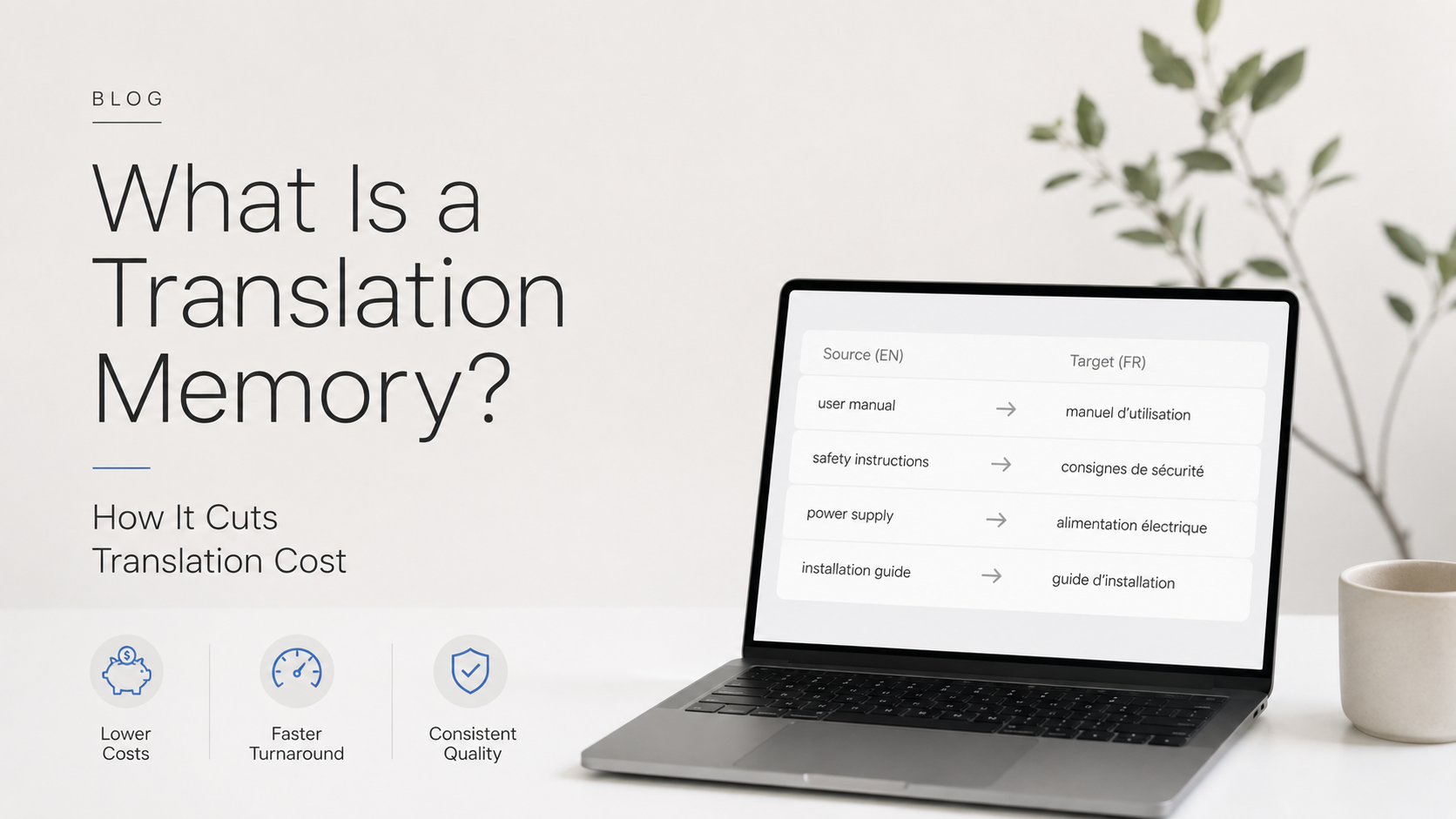
What Is a Translation Memory — and How It Saves You Money on Repeat Work
Quick answer: A translation memory (TM) is a database that stores sentences and phrases you’ve already had translated, then automatically reuses them whenever the same or similar text comes up again. Because you don’t pay full price to re-translate content you’ve translated before, a translation memory lowers cost and turnaround on repeat, updated, and high-volume projects — while keeping your terminology consistent across everything you publish.
If your business translates regularly — translation for product manuals, software updates, catalogues, contracts, marketing refreshes — you’re almost certainly paying to translate the same sentences more than once without realising it. A translation memory is the technology that stops that waste. It’s one of the most practical cost-savers in professional translation, yet most buyers have never had it explained. Here’s what it is, how it works, and why it matters to what you pay.
What is a translation memory?
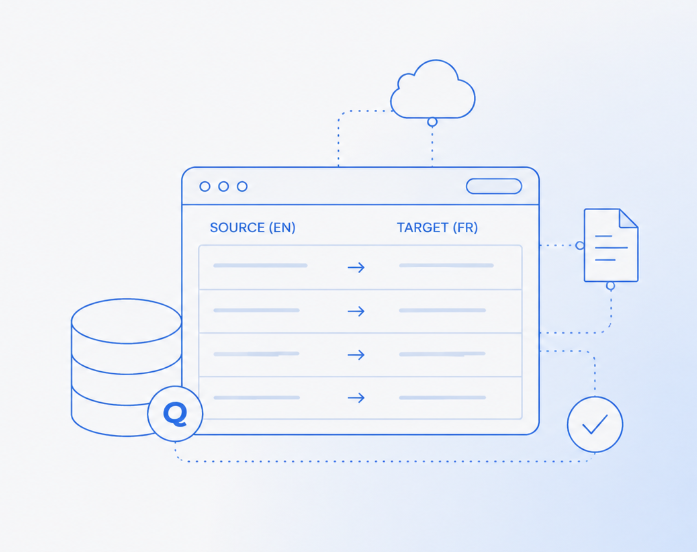
A translation memory is a database that stores your previously translated content as paired segments — each source sentence alongside its approved translation. When you send new content for translation, the system checks it against this database. Anything that matches something already translated is pulled from the memory instead of being translated from scratch. Over time, as your memory grows, more and more of each new project can be reused.
Importantly, a translation memory is not machine translation. It doesn’t generate new translations with AI — it reuses translations that your human linguists already produced and approved. It’s a memory of your own prior work, owned by you, that gets more valuable with every project.
How does a translation memory work?
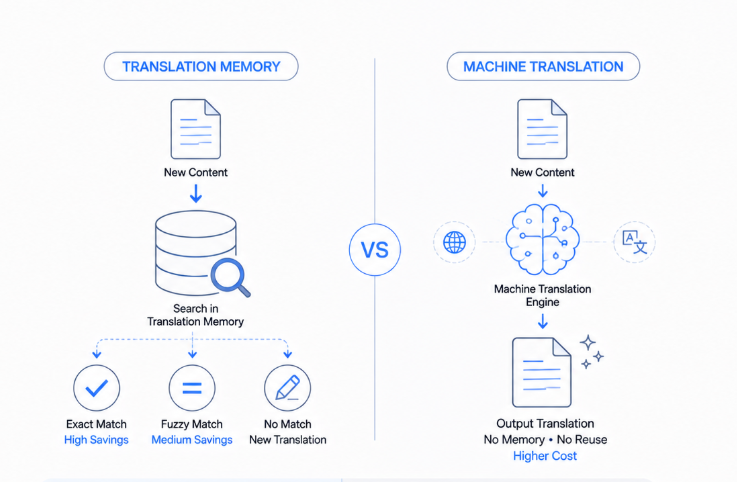
A translation memory works by breaking text into segments (usually sentences) and comparing each new segment against what’s stored. There are three types of match:
- Exact match (100%) : the sentence is identical to one already in the memory. It’s reused directly, at little or no cost.
- Fuzzy match (partial) : the sentence is similar but not identical — say a manual where only a model number changed. The stored translation is offered to the linguist, who adjusts just the difference. Much faster than translating fresh.
- No match (new) : the sentence is new. The linguist translates it, and it’s added to the memory for future reuse.
The linguist stays in control throughout — the memory speeds up and standardises the work, but a human reviews and approves everything. Nothing is auto-published.
How does a translation memory save money?
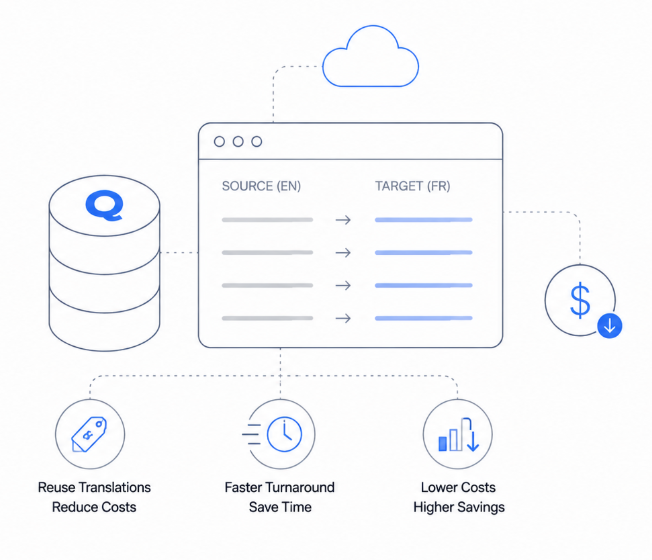
A translation memory saves money because you don’t pay full rate to re-translate content you’ve already translated. Most professional providers price TM matches on a sliding scale — exact matches cost a fraction of the new-word rate, fuzzy matches somewhere in between, and only genuinely new content is charged in full. The more repetitive or frequently-updated your content, the bigger the saving.
The effect compounds over time. Your first project builds the memory; every project after that draws on it. For businesses with ongoing translation needs, this can mean substantial reductions on later work — you’re effectively investing in an asset that keeps paying back.
Where translation memory saves the most ?
Translation memory delivers the biggest savings where content repeats or updates rather than being written fresh each time:
- Technical manuals and user guides — heavily repetitive, and updated version to version rather than rewritten
- Software and app content — strings that recur across screens releases
- Product catalogues and datasheets — repeated structures specifications
- Legal and contractual documents — standard clauses that appear again
- Ongoing and high-volume accounts — where the memory grows across many projects
A worked example: what translation memory saves in practice
Say you have a 10,000-word product manual, and next year you release an updated model. Most of the manual — safety information, installation steps, general operation — hasn’t changed; only about 30% is new or revised. Without a translation memory, you’d pay to translate all 10,000 words again. With a translation memory:
- ~7,000 words match content already translated (exact and fuzzy matches) → charged at a fraction of the full rate
- ~3,000 words are genuinely new → charged at the standard rate
You’ve effectively paid full price for 3,000 words instead of 10,000 — on a document you’d otherwise have translated twice. Across a catalogue of manuals updated every year, that saving repeats on every revision, in every language. That’s the compounding value of a translation memory: the more you translate, the less each future project costs.
(Note: exact percentages and match rates vary by content — this illustrates how the saving works, not a fixed quote. Your actual savings depend on how repetitive your content is.)
+91 96000 44222
Translation Memory vs Machine Translation vs Glossary
| Queries | Translation Memory | Machine Translation | Glossary / Termbase |
| What it stores | Whole translated sentences you’ve approved | Nothing — generates fresh output each time | Approved translations of individual terms |
| Source of content | Your own past human translations | AI, generated on demand | Your approved terminology |
| Human-approved? | Yes — reuses signed-off content | No — raw output until reviewed | Yes |
| Main benefit | Cost saving + consistency on repeat work | Speed on brand-new content | Terminology consistency |
| Best for | Manuals, updates, high-volume, ongoing accounts | Rough drafts, gisting, high-volume raw text | Brand names, technical terms, product vocabulary |
Used together in a professional workflow — memory for reuse, glossary for terminology, and human linguists for quality — you get translations that are consistent, efficient, and accurate.
Translation memory vs machine translation
— what’s the difference?
They’re often confused, but they’re fundamentally different. Machine translation uses AI to generate a brand-new translation of text it has never seen. Translation memory reuses translations that your human linguists already created and approved. Machine translation produces raw, unreviewed output that may or may not be accurate; a translation memory recycles content that’s already been quality-checked and signed off. The two can be used together in a professional workflow — but a translation memory is about consistency and reuse of trusted content, not automated generation.
Translation memory vs glossary collection
— how do they work together?
A glossary (or termbase) stores approved translations of individual terms — your product names, technical vocabulary, brand wording. A translation memory stores whole translated sentences and segments. Used together, they keep your translations both consistent in terminology (glossary) and efficient through reuse (memory). Professional providers maintain both for ongoing clients, which is why long-term translation partnerships get faster, cheaper, and more consistent over time.

How Quadrate uses translation memory ?
At Quadrate, translation memory is part of how we deliver consistency and value on every ongoing account. We build and maintain a dedicated memory for each client, apply it across all their projects, and price TM matches fairly so the savings reach you — not just us. Combined with client glossaries and human quality assurance, it means your terminology stays consistent across years of documentation, your turnaround shortens as the memory grows, and you stop paying to translate the same content twice.
The memory is your asset, built from your approved translations, working for you on every future project.
Follow us on LinkedIn for Industrial translation Insights
FAQ (Translation Memory & Glossary)
What is a translation memory in simple terms?
A translation memory is a database that stores your previously translated sentences and reuses them when the same or similar text appears again, so you don’t pay to translate the same content twice.
Is translation memory the same as machine translation?
No. Machine translation uses AI to generate new translations, while a translation memory reuses translations your human linguists already produced and approved. A translation memory reuses trusted, quality-checked content rather than generating new output.
How much can a translation memory save?
Savings depend on how repetitive or frequently-updated your content is. Exact and fuzzy matches are charged at reduced rates, so repetitive content like manuals, software, and catalogues can see significant reductions, and savings grow as the memory builds over time.
Who owns the translation memory?
The translation memory is built from your approved translations and is your asset. A professional provider maintains it on your behalf and applies it across your projects.
What is the difference between a translation memory and a glossary?
A glossary stores approved translations of individual terms, while a translation memory stores whole translated sentences and segments. Used together, they keep translations consistent and efficient.
Does using a translation memory reduce translation quality?
No. A translation memory reuses content already translated and approved by human linguists, and every project is still reviewed by a linguist, so it improves consistency without lowering quality.