Translation Services in Tamil Nadu: A District-by-District Guide for Exporters and Manufacturers
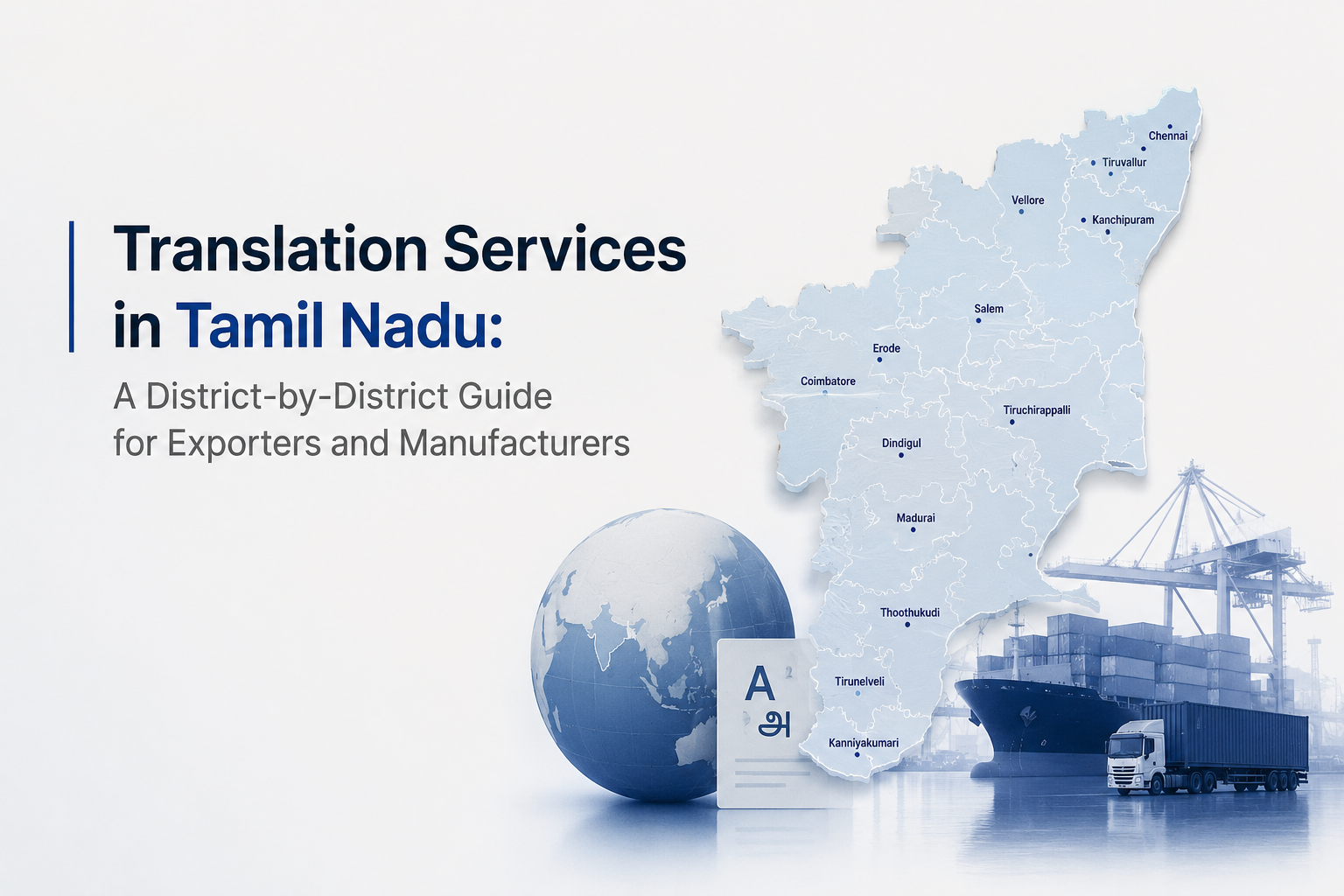
Translation Services in Tamil Nadu : A District-by-District Guide for Exporters and Manufacturers
Tamil Nadu’s exporters need different languages depending on where they sit. Tiruppur’s knitwear buyers are in Germany, France and Italy. Coimbatore’s pump manufacturers ship to Africa and the Gulf. Hosur’s auto suppliers answer to Japanese and Korean OEMs. Trichy’s heavy engineering firms bid on Russian and Arabic tenders. This guide breaks down what each industrial district actually needs translated, into which languages, and why getting it wrong costs more than getting it right.
How to use this guide ?
Find your district. Read what your buyers typically need. Then skip to the sections on document types and language priorities, which apply regardless of where you’re based. If your district isn’t listed, the closest industrial match is usually the right guide. A fabrication unit in Cuddalore has more in common with Trichy than with Chennai.
info@quadrate.co.in
+91 96000 44222

Why export documentation gets translated badly in Tamil Nadu ?
There is a pattern we see repeatedly, and it usually starts with a purchase order.
A buyer in Düsseldorf places a first order. The contract arrives in German. Someone in the export department runs it through a free tool, reads the gist, and signs. Nine months later there’s a dispute over a delivery clause, and it turns out the German original said something the English gist did not.
Or: a shipment reaches Rotterdam and gets held because the product safety information isn’t in Dutch. The goods sit in a bonded warehouse accruing charges while somebody scrambles to get labels reprinted.
Or, most expensively: an EU buyer runs a factory audit, asks to see the Tamil-language version of the safety procedures posted on the shop floor, and finds the SOPs exist only in English — which most of the machine operators cannot read.
None of these are translation problems in the narrow sense. They’re documentation problems that surface as translation problems, usually at the worst possible moment.
Tamil Nadu exported goods worth several lakh crore rupees in recent years, and the state consistently ranks among India’s top exporting states by value. Behind that number sits a very large volume of paper: contracts, technical packs, test reports, declarations of conformity, installation manuals, safety data sheets, customs documentation, buyer correspondence. A meaningful share of it needs to exist in a language other than English, and a meaningful share of that is handled by whoever in the office is thought to be good with computers.
The specific thing that makes European exports harder than most exporters expect
Two rules catch Tamil Nadu manufacturers out more than any others.
The first is that the European Union generally requires product information — safety instructions, warnings, user manuals for a wide range of products — to be supplied in the official language or languages of the member state where the product is sold. Not English. Not “an EU language.” The language of the country. Ship to Belgium and you’re often looking at Dutch and French. Ship to Finland and it’s Finnish and Swedish.
The second is that this obligation sits with whoever places the product on the EU market. Exporters sometimes assume it’s the importer’s problem. Contractually it often becomes yours, because the importer will push the cost back down the chain the moment goods are refused.
The practical consequence: if you’re selling into six EU countries, you may be looking at manuals and labelling in six to nine languages, maintained across every product revision. That’s not a one-off translation job. That’s an ongoing content operation, and it’s the point at which most exporters realise they need a process rather than a vendor.
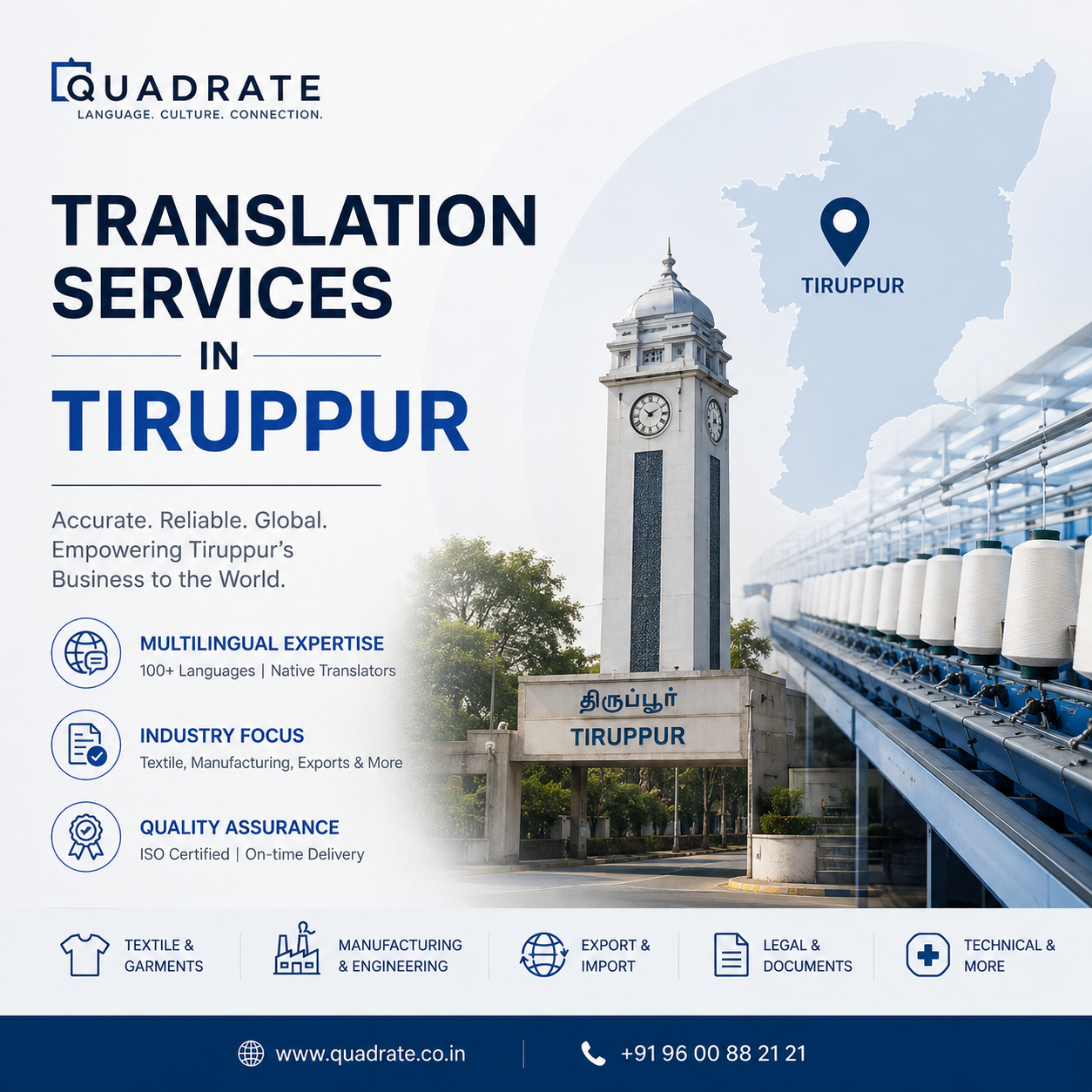
Translation services in Tiruppur:
knitwear, and the European labelling trap
Tiruppur is India’s largest knitwear export cluster. The buyer base is heavily European — Germany, France, Italy, the Netherlands, Spain, the Nordics — with substantial US and UK volume alongside.
What actually needs translating here
Buyer contracts and purchase agreements come first, and they’re where the money is. European apparel buyers write detailed terms: delivery windows, penalty clauses, quality tolerances, chargeback conditions, compliance undertakings. Signing an English summary of a German or Italian contract is a habit worth breaking.
Then there’s the compliance stack. Apparel sold in the EU carries fibre composition labelling requirements, and the required information generally has to appear in the language of the country of sale. Care instructions travel with the garment. Restricted substances declarations, oeko-tex style certifications, and buyer-specific chemical compliance documentation all move between your lab and their compliance team, often in the buyer’s language.
Tech packs and specification sheets are the third category and the one most often neglected. When a buyer’s technical team writes construction notes in Italian and your sampling unit reads a rough English paraphrase, you get sampling rounds that shouldn’t have been necessary.
Finally: audit documentation. Social compliance and factory audits are routine in this sector. Auditors increasingly want to see that worker-facing documentation — safety procedures, grievance mechanisms, wage explanations — exists in a language the workforce reads. In Tiruppur that means Tamil, and often also Hindi, Odia, Bengali or Assamese, because a large share of the workforce is migrant.
That last point is worth sitting with. Most exporters think of translation as an outbound activity aimed at buyers. In Tiruppur, some of the highest-value translation work points inward, at your own shop floor, and it’s what keeps audits clean.
Languages, in rough priority order: German, French, Italian, Spanish, Dutch, and Tamil plus migrant-worker languages for internal documentation.
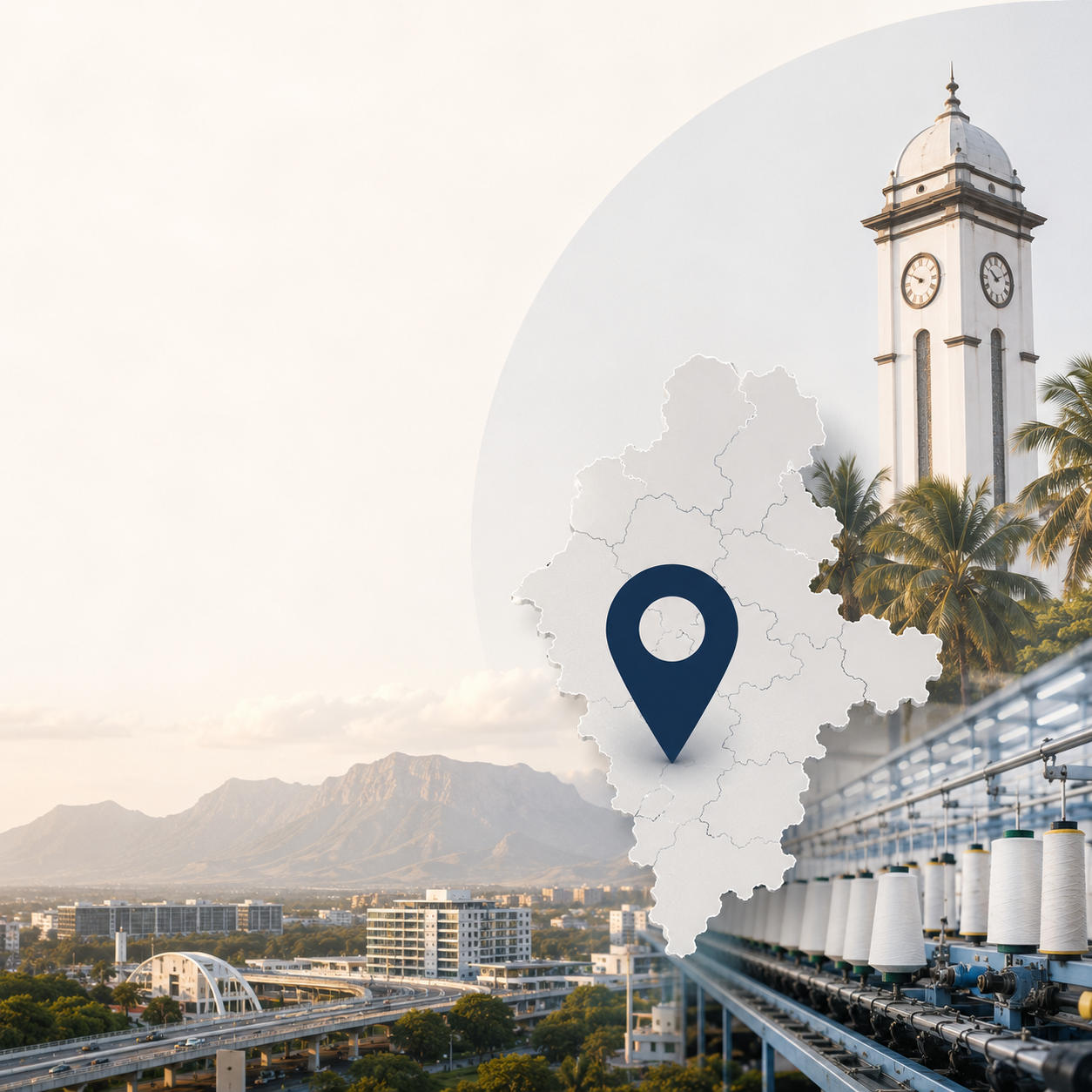
Coimbatore: pumps, motors and machinery for markets
Coimbatore is the engineering heart of the state — pumps and motors above all, plus textile machinery, foundries, castings, wet grinders and a deep auto component base. It’s a genuinely export-oriented cluster, and the destination mix is unusual: a great deal of it goes to Africa, the Middle East, and Latin America, not just Europe.
That destination mix changes the language calculus completely.
What actually needs translating here
Installation, operation and maintenance manuals are the core deliverable. A submersible pump sold in Francophone West Africa needs a French manual. One sold in Angola or Mozambique needs Portuguese. Latin American distributors want Spanish. Gulf buyers want Arabic, and often want it laid out right-to-left properly rather than pasted into an English template.
That last detail causes more grief than the translation itself. Arabic requires genuine right-to-left typesetting. Tables, callouts, exploded diagrams and part numbering all have to be rebuilt, not just re-typed. If your DTP is handled by someone who doesn’t work in Arabic regularly, you get manuals that are technically translated and practically unusable.
Technical datasheets, performance curves and dimension drawings sit alongside the manuals. Drawings often carry embedded text that has to be extracted, translated and reinserted without breaking the CAD file.
Then there’s the machinery compliance layer for European sales: declarations of conformity, safety instructions, residual risk warnings. EU machinery rules are strict about safety-critical information appearing in the language of the user.
Spare parts catalogues are the quiet money-maker. A distributor who can order parts confidently in their own language orders more parts.
Languages, in rough priority order: French, Spanish, Portuguese, Arabic, German, and Russian for certain segments.
One practical suggestion for Coimbatore manufacturers: build a bilingual terminology list before you translate anything. Pump and motor terminology is unforgiving — “head,” “duty point,” “impeller clearance,” “NPSH” — and if two manuals translate the same term differently, your distributor loses confidence in both. A terminology base costs a little at the start and saves a great deal across every subsequent document revision.
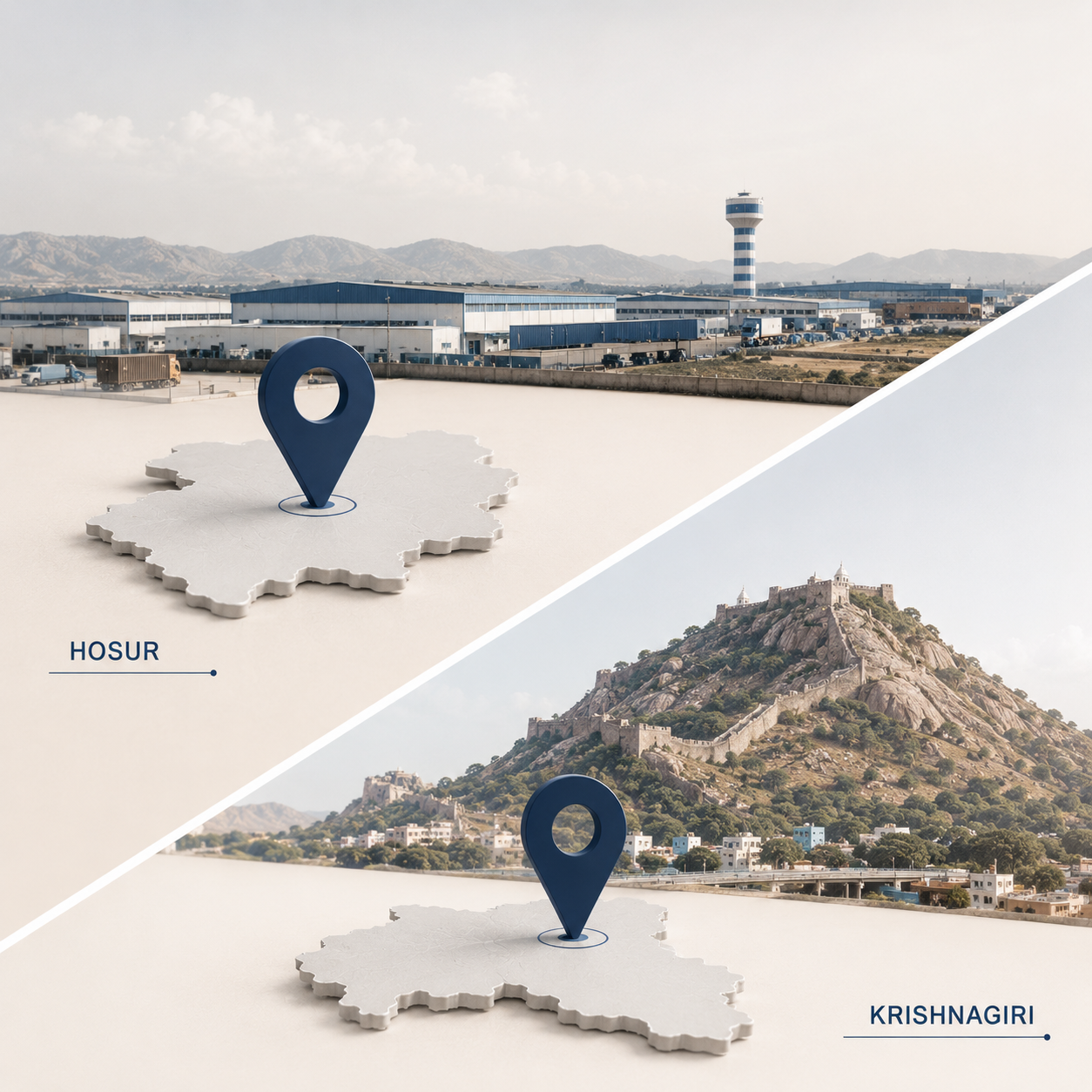
Hosur and Krishnagiri:
automotive, electronics and the OEM documentation chain
The Hosur belt runs on automotive and electronics manufacturing, with a growing electric vehicle presence. The defining characteristic for translation purposes is that many companies here are suppliers rather than brand owners, which means they sit inside someone else’s documentation system.
What actually needs translating here
Supplier quality documents flow downward from the OEM: PPAP packages, control plans, FMEA documentation, process audit criteria, corrective action reports. If the OEM is Japanese, Korean or German, some of this arrives in the OEM’s language, and getting it wrong doesn’t just cause confusion — it can cause a failed audit.
Service and workshop manuals flow outward. So do parts catalogues, warranty documentation and technical service bulletins.
Then there’s the training layer, which is growing fast. Manufacturers running multilingual workforces and multi-site operations increasingly deliver technical training through e-learning, and that content has to be localised properly — not just the slides, but the voice-over, the on-screen text, the quiz logic and the completion tracking. Getting subtitles and audio synchronised across eight languages while keeping the interactive elements functional is a specialist job, and it’s one of the few areas where doing it badly is immediately obvious to the learner.
Languages, in rough priority order: Japanese, Korean, German, Chinese, plus Tamil and Hindi for shop-floor and training material.
A note specific to this cluster: Japanese and Korean technical documentation is dense, highly conventionalised, and full of standard phrasing that carries precise meaning. A generalist translator will produce something readable and subtly wrong. This is the segment where subject-matter specialisation matters most and where the cost difference between a specialist and a generalist is smallest relative to the risk.
Sriperumbudur and the Chennai industrial corridor
The corridor west and south of Chennai — Sriperumbudur, Oragadam, Irungattukottai, Maraimalai Nagar — is one of India’s densest manufacturing zones, covering automotive assembly, electronics, and a very large tier-one and tier-two supplier base.
What actually needs translating here
Standard operating procedures and work instructions, in volume. These plants run large workforces, and the operating language on the floor is Tamil, with significant Hindi and other Indian languages among migrant workers. Meanwhile the engineering documentation originates in Korean, Japanese, Chinese or German. Translation here is largely an internal function, and it’s continuous rather than project-based.
Quality documentation moves in both directions: inspection standards downward from the parent company, non-conformance reports and root cause analyses upward.
Equipment manuals arrive with imported machinery, frequently in the language of the machine builder, and have to be made usable for maintenance teams.
Safety documentation is non-negotiable and must be in the language the worker reads. Regulators and auditors both check this.
Languages, in rough priority order: Korean, Japanese, Chinese, German, English↔Tamil, English↔Hindi.
The pattern worth naming: in this corridor, translation is infrastructure rather than a service you buy occasionally. Companies that handle it well build a terminology base, keep a translation memory, and route everything through one consistent process. Companies that handle it badly send each document to whoever is available, accumulate inconsistent terminology across thousands of documents, and eventually have to redo it.
Tiruchirappalli:
heavy engineering, boilers and tender documentation
Trichy is India’s boiler and heavy fabrication centre, anchored by a large public sector presence and surrounded by a substantial private fabrication ecosystem. The work here is project-based and often international, which produces a very particular translation profile.
What actually needs translating here
Tender and bid documentation dominates. International project tenders — power, oil and gas, infrastructure — arrive in the client’s language and carry commercial terms that must be understood exactly. A misread liquidated damages clause on a project contract is not a small mistake.
Project execution documents follow: engineering drawings, welding procedure specifications, quality assurance plans, inspection and test plans, material test certificates, as-built documentation.
Then there’s the handover package, which is often contractually specified and language-specific. Operation and maintenance manuals for a power plant in Algeria or Kazakhstan have to be delivered in the working language of the client’s operations team.
Languages, in rough priority order: Arabic, French, Russian, Spanish, Portuguese.
What makes this segment different: the documents are enormous, the deadlines are contractual, and the terminology is highly regulated by international standards. This is the segment where translation memory pays for itself fastest, because project documentation repeats heavily across bids. If you’re bidding regularly and translating from scratch each time, you’re paying two or three times for the same sentences.
Thoothukudi and the port economy
Thoothukudi’s economy runs on its port, plus chemicals, salt, thermal and wind power, and a growing logistics base. Nearby Tirunelveli adds textiles and light manufacturing.
What actually needs translating here
Shipping and customs documentation is the daily volume: bills of lading, certificates of origin, packing lists, inspection certificates, phytosanitary and quality certificates for agricultural exports.
Charter parties and freight contracts matter disproportionately, because shipping contracts are notoriously precise and the consequences of ambiguity are financial and immediate.
Chemical exports bring safety data sheets, which are legally required in the language of the destination country in most major markets. SDS translation is one of the clearest examples of translation as a compliance obligation rather than a convenience — the format is prescribed, the content is regulated, and errors have safety consequences.
Renewable energy documentation is a growing category as wind and solar equipment moves both in and out of the region.
Languages, in rough priority order: Arabic, Chinese, French, Spanish.
Ranipet, Ambur and Vellore:
leather, footwear and European buyer compliance
The Palar valley leather cluster is one of India’s oldest export industries, supplying finished leather and footwear largely to European buyers.
What actually needs translating here
Buyer specifications and technical sheets, usually from Italian, Spanish or German buyers, and usually detailed. Leather is a material with a lot of variables, and specification precision matters.
Chemical compliance documentation is unusually heavy in this sector. European restrictions on substances used in leather processing are strict, and the associated declarations, test reports and compliance certificates move constantly between tanneries, labs and buyers.
Environmental compliance documentation has become a buyer requirement as well as a regulatory one, particularly around effluent treatment.
Audit documentation, as in Tiruppur, needs a worker-facing Tamil layer.
Languages, in rough priority order: Italian, Spanish, German, French.
Sivakasi and Virudhunagar:
printing, packaging and safety labelling
Sivakasi is India’s printing and fireworks capital, and both industries generate translation work of a specific kind.
What actually needs translating here
Packaging and label content for export markets, which is where translation meets typesetting most directly. A label has a fixed physical area. German runs roughly a third longer than English. Text that fits in the English version will not fit in the German version, and somebody has to redesign rather than shrink the font to an illegal size.
Safety warnings and hazard information for fireworks and pyrotechnic exports are legally prescribed in most markets, and the wording is often standardised. This is not free-translation territory.
Print job specifications and buyer artwork instructions round it out.
Languages: varied, driven by the export destination for each print job. Expect European languages plus Arabic.
The point worth emphasising for this cluster: in packaging work, the translation and the layout are one job, not two. Sending translated text to a designer who doesn’t read the language produces labels with broken hyphenation, wrong diacritics, and text truncated mid-word. Desktop publishing in the target language has to be part of the workflow.
Madurai, Salem, Erode, Karur and Namakkal:
the wider industrial base
These districts share a profile: substantial manufacturing, growing export activity, and translation needs that are real but less concentrated than in the specialised clusters.
- Madurai — textiles, rubber, granite, and a fast-growing IT and healthcare base. Increasingly a source of medical tourism documentation, which brings its own requirements around patient records and consent forms.
- Salem — steel, textiles, magnesite and sago. Technical documentation and buyer correspondence, largely for Asian and Middle Eastern markets.
- Erode — textiles and turmeric. Agricultural export certification alongside textile documentation.
- Karur — home textiles, exporting heavily to Europe and the US. Similar profile to Tiruppur with a different product set.
- Namakkal — poultry and transport. Veterinary and food safety documentation for export markets.
Common languages across this group: German, French, Italian, Arabic, and English↔Tamil for internal and certification purposes.

Translation Services in Chennai:
the state’s translation and documentation hub
Chennai sits at the centre of this map for a straightforward reason — it’s where the linguists, the certification infrastructure, the consulates and the notary and attestation network are concentrated.
For exporters elsewhere in Tamil Nadu, that has a practical implication: certified and attested documents almost always route through Chennai regardless of where the business is based. Understanding that from the start saves a week.
Chennai’s own industrial base — automotive, IT, healthcare, port and logistics — generates its own substantial translation demand, covered in more depth on our translation services in Chennai page.
What actually needs translating: the document checklist
Cutting across every district, these are the categories that come up repeatedly. Use it as an audit of your own documentation.
Commercial and contractual
Purchase agreements, distribution and agency agreements, terms and conditions, non-disclosure agreements, letters of credit and banking correspondence, buyer communication.
Technical
Installation, operation and maintenance manuals; user guides; technical datasheets and specifications; engineering drawings with embedded text; bills of materials; spare parts catalogues; software and interface strings for connected products.
Regulatory and compliance
Declarations of conformity; safety data sheets; test and inspection reports; certificates of analysis; restricted substances declarations; product labelling and warnings; environmental and social compliance documentation.
Logistics and customs
Commercial invoices, packing lists, bills of lading, certificates of origin, insurance documentation, phytosanitary and health certificates.
Internal and workforce
Standard operating procedures, work instructions, safety procedures, training material, HR policies, quality manuals.
Marketing
Product catalogues, brochures, websites, trade fair material, case studies, presentations.
That last category deserves a caution. Marketing content should be transcreated rather than translated — rewritten to work in the target culture rather than converted word by word. A product brochure translated literally into German reads as though a foreigner wrote it, which is precisely the impression an exporter is trying to avoid. Buyers notice, and they draw conclusions about your attention to detail elsewhere.

Which languages should a Tamil Nadu exporter actually invest in?
Priorities depend on your destination markets, but there’s a defensible general ranking for the state’s export profile.
German earns its place at the top. It’s the language with the widest reach across Tamil Nadu’s industrial base, showing up in Tiruppur’s knitwear contracts, Coimbatore’s machinery documentation, Karur’s home textile business, Hosur’s automotive supply chains and Ranipet’s leather exports. German buyers tend to write detailed contracts and expect detailed compliance documentation in return, which means the work spans commercial agreements, technical manuals, conformity declarations and product labelling. If you export to Europe and can only afford to do one language properly, this is usually the one.
French runs a close second, and it’s underestimated by most exporters because they think only of France. The larger opportunity is Francophone West and North Africa, where a great deal of Coimbatore’s pump and motor output ends up, and where Trichy’s heavy engineering firms bid on infrastructure and power projects. Add Tiruppur’s French apparel buyers and you have a language that covers manuals, tender documentation, contracts and labelling across three very different markets.
Spanish and Portuguese work as a pair for most Tamil Nadu manufacturers, because the destinations overlap. Spanish opens Latin America and Spain, taking in Coimbatore’s machinery exports and Ranipet’s leather buyers. Portuguese covers Brazil and Lusophone Africa — Angola and Mozambique in particular are meaningful markets for Indian pumps and industrial equipment. In both cases the documents are much the same: operation and maintenance manuals, product catalogues, distributor agreements and spare parts listings.
Arabic is the highest-value language on this list for a specific segment. Trichy’s project and tender documentation, Coimbatore’s Gulf-bound machinery, and Thoothukudi’s port and chemical trade all depend on it. It’s also the language where cutting corners is most visible, because Arabic needs genuine right-to-left typesetting rather than translated text dropped into an English layout. Tenders, project documentation, manuals and labelling all fall in scope, and a poorly set Arabic manual undermines a bid before anyone reads the technical content.
Italian matters most to the Palar valley leather cluster and to Tiruppur, where Italian buyers are demanding on specification detail. It also appears wherever Italian machinery has been imported, since the equipment documentation arrives in Italian and has to be made usable for maintenance teams. Expect specification sheets, buyer correspondence and compliance documentation.
Japanese and Korean belong to the OEM supply chain rather than to general export. Hosur and Sriperumbudur suppliers sit inside documentation systems designed by Japanese and Korean parent companies, which means quality documentation, OEM standards, process audit criteria and technical training material all move in those languages. This is the segment where subject-matter specialisation matters most: both languages use dense, highly conventionalised technical phrasing where a generalist translator produces something readable and subtly wrong.
Chinese covers the electronics supply chain around Sriperumbudur and the trade and shipping documentation flowing through Thoothukudi. Supply chain correspondence, technical specifications and logistics paperwork make up most of the volume.
Russian is narrow but valuable, concentrated almost entirely in Trichy’s heavy engineering sector and its project work across the CIS states. When it’s needed, it’s needed for tender submissions and project documentation running to hundreds of pages, which is exactly the situation where translation memory pays for itself.
Dutch rounds out the European set, driven by Benelux buyers in Tiruppur and Karur. The volume is smaller and the work is concentrated in labelling and compliance, but it’s often non-negotiable, because Belgium and the Netherlands enforce local-language product information consistently.
Finally, Tamil — and it belongs on this list for a reason that catches exporters off guard. A large share of the translation work in this state points inward, not outward. Standard operating procedures, safety instructions, work instructions and training material need to exist in the language your shop floor actually reads, and European buyer audits increasingly check for exactly that. Alongside it sits a steady stream of certified Tamil-to-English work: birth certificates, degree certificates, community and income certificates, and corporate registration documents required by foreign authorities. The outward-facing translation wins you buyers. The inward-facing translation keeps your audits clean and your workforce safe, and it’s the one most manufacturers never put in a budget.
Certified, technical or marketing translation:
which do you need?
These are three different services, priced differently, and buying the wrong one wastes money in both directions.
Certified translation carries a signed statement of accuracy from the translator or agency. You need it when a government body, court, university, consulate or regulator will receive the document. Birth and marriage certificates, degree certificates, company registration documents, affidavits, court filings. It can be notarised or apostilled where the receiving authority requires it.
Technical translation is about subject-matter accuracy and terminology consistency. You need it for manuals, specifications, SOPs, engineering documentation and compliance material. Certification is usually irrelevant here; what matters is that the translator understands centrifugal pumps or ISO welding standards, and that terminology stays identical across every document you ever publish.
Transcreation is for anything persuasive — brochures, websites, campaigns, trade fair material. The output is judged on whether it works on the reader, not on whether it matches the source sentence by sentence.
A rough test: if a stamp matters, it’s certified. If a term matters, it’s technical. If the reader’s reaction matters, it’s transcreation.

Seven mistakes that cost
Tamil Nadu exporters real money
1. Translating the same content repeatedly without a translation memory. Export documentation repeats heavily. Product families share text. Tender responses reuse boilerplate. Manual revisions change ten percent and keep ninety. Without a translation memory, you pay full price for that ninety percent every time. Exporters producing documentation at any volume typically see costs fall substantially within a year of putting one in place, and the savings compound.
2. Treating translation and layout as separate jobs. Text expands and contracts between languages. German and French run longer than English. Chinese and Japanese run shorter but need different line breaking. Arabic reverses direction. Tamil has its own typesetting requirements. Send translated text to a designer who doesn’t read the language and you get broken output. Desktop publishing in the target language belongs inside the workflow.
3. Letting terminology drift. If your pump is a “booster pump” in one manual and a “pressure pump” in the next, your distributor’s confidence drops and your parts ordering gets messy. Terminology consistency is not pedantry in technical export — it’s a functional requirement. Build a glossary early.
4. Using machine translation for anything with legal or safety weight. Machine translation has genuinely improved and it has real uses: internal gist reading, first-pass drafts, high-volume low-risk content. It is not appropriate, unreviewed, for contracts, safety warnings, regulatory declarations or anything a court or auditor might read. The failure mode is that it produces fluent, confident, plausible output that is wrong in a way a non-speaker cannot detect.
5. Assuming your importer will handle language compliance. Sometimes they will. Often the contract says otherwise, and even where it doesn’t, the commercial cost of refused goods lands on you.
6. Leaving certified documents until the last week. Certification, notarisation and apostille each take time, and they run in sequence. Translate, then certify, then notarise if required, then apostille. Doing it out of order means starting again.
7. Ignoring the internal audience. The translation that prevents an accident on your shop floor is worth more than the one that impresses a buyer. Safety procedures, work instructions and training material in the language your workforce actually reads is the highest-return translation most manufacturers never budget for.
Working with a translation partner from outside Chennai
Most translation work no longer requires anyone to travel. The practical questions are about handover and hard copies.
Digital documents move by secure file transfer. Source files matter: send the InDesign or CAD or Word source rather than a flattened PDF, and the returned file will be usable rather than something your team has to rebuild.
Hard copies — for certified translations requiring physical seals and signatures — are couriered. Anywhere in Tamil Nadu is one to two days from Chennai, and the certification itself is usually the longer part of the timeline.
Scoping happens over a call. For anything technical, expect to be asked for sample documents, existing terminology, previous translations and the file formats involved. An agency that quotes without asking these questions is quoting on assumptions.
Turnaround varies by document type and language pair. Certified personal documents are typically quick. Technical manuals in multiple languages with DTP take longer, and rush handling is possible but should be planned rather than assumed.
Frequently asked questions
Do I need my export documents translated by a certified agency, or can my staff do it? For internal understanding, staff translation is fine. For anything a buyer, regulator, court or customs authority will act on, use a professional service. The distinction is liability: a certified translation carries a signed accuracy statement that transfers responsibility to the provider. An in-house translation does not.
What is the difference between certified and notarised translation? A certified translation includes a signed statement from the translator or agency attesting that the translation is accurate and complete. A notarised translation adds a notary’s verification of the translator’s identity and signature. The notary does not check the translation itself. Many authorities require certification only; some require both. Check what the receiving body specifies rather than buying both by default.
Does the EU really require manuals in every local language? For a wide range of products, yes — safety and user information generally has to be provided in the official language or languages of the member state where the product is sold. The specific obligation depends on the product category and the applicable regulation, so confirm the requirement for your product rather than assuming a general rule.
How much does technical translation cost in India? Pricing is normally per source word and varies by language pair, subject matter, turnaround and whether desktop publishing is included. European languages generally cost less than Japanese, Korean or Nordic languages. Volume, repetition and translation memory reduce the effective rate considerably over time. Ask for a rate card rather than a single project quote if you expect ongoing work.
Can I use Google Translate or ChatGPT for my export documents? For understanding an incoming email quickly, yes. For anything that carries legal, safety or regulatory weight, no — not without professional review. The risk is not that machine output is obviously bad. It’s that it’s fluent and wrong, and you have no way to detect the difference.
How long does certified translation take? Standard personal and corporate documents are usually fast. Technical documentation in multiple languages with formatting takes longer. Apostille and embassy attestation add separate timelines that sit outside the translation itself.
What is a translation memory and do I need one? A translation memory is a database of your previously translated sentences, reused automatically when the same or similar text appears again. If you publish documentation regularly, revise manuals, or bid on tenders, you need one. It cuts cost, speeds delivery and — more importantly — keeps terminology consistent across everything you publish.
Do you translate engineering drawings and CAD files? Yes, and the file format matters. Text embedded in drawings has to be extracted, translated and reinserted without breaking the file, which is a different job from translating a document.
What about Tamil to English certificate translation for visas and higher studies? This is one of the most common requests we handle. Birth certificates, marriage certificates, degree and transcript documents, community and income certificates. One point worth knowing in advance: Tamil names are frequently transliterated inconsistently across different documents, and mismatches between certificates are a common cause of rejection. Flag any spelling variations at the start so they can be handled correctly.
Do you work with companies outside Chennai? Yes. Most work is handled remotely, with hard copies couriered where physical certification is required.
Can you handle documentation in ten languages at once? Yes, and multilingual projects are usually more efficient than sequential single-language ones, because terminology and formatting are resolved once rather than ten times.
What file formats do you accept? Word, Excel, PowerPoint, PDF, InDesign, FrameMaker, XML, HTML, XLIFF, AutoCAD and standard e-learning formats. Source files always produce better results than PDFs.
How do you protect confidential documents? Confidentiality agreements with every linguist, controlled file access, and NDAs with clients on request. Ask any prospective provider about this specifically — export documentation frequently contains pricing, designs and buyer information you would not want circulating.
Where to start your Translation journey ?
If you’re exporting from Tamil Nadu and your documentation is currently handled ad hoc, the sequence that works is straightforward.
Start with an audit: list every document that leaves your company in a language other than English, and every document your workforce needs but cannot read. Most companies are surprised by the length of the list.
Then triage. Anything with legal, safety or regulatory weight goes first. Anything that gets reused repeatedly goes second, because that’s where a translation memory pays back fastest. Marketing goes last, and gets transcreated rather than translated.
Then build the infrastructure once: a terminology base, a translation memory, and a single consistent process. It costs more in month one and less in every month after.
Quadrate has worked with manufacturers, exporters and engineering firms across Tamil Nadu for over 17 years, with ISO 17100 certified processes and native linguists across 100+ languages. If you’d like to talk through what your documentation actually requires — including the parts you may not have budgeted for — we’re happy to scope it with you before you commit to anything.