
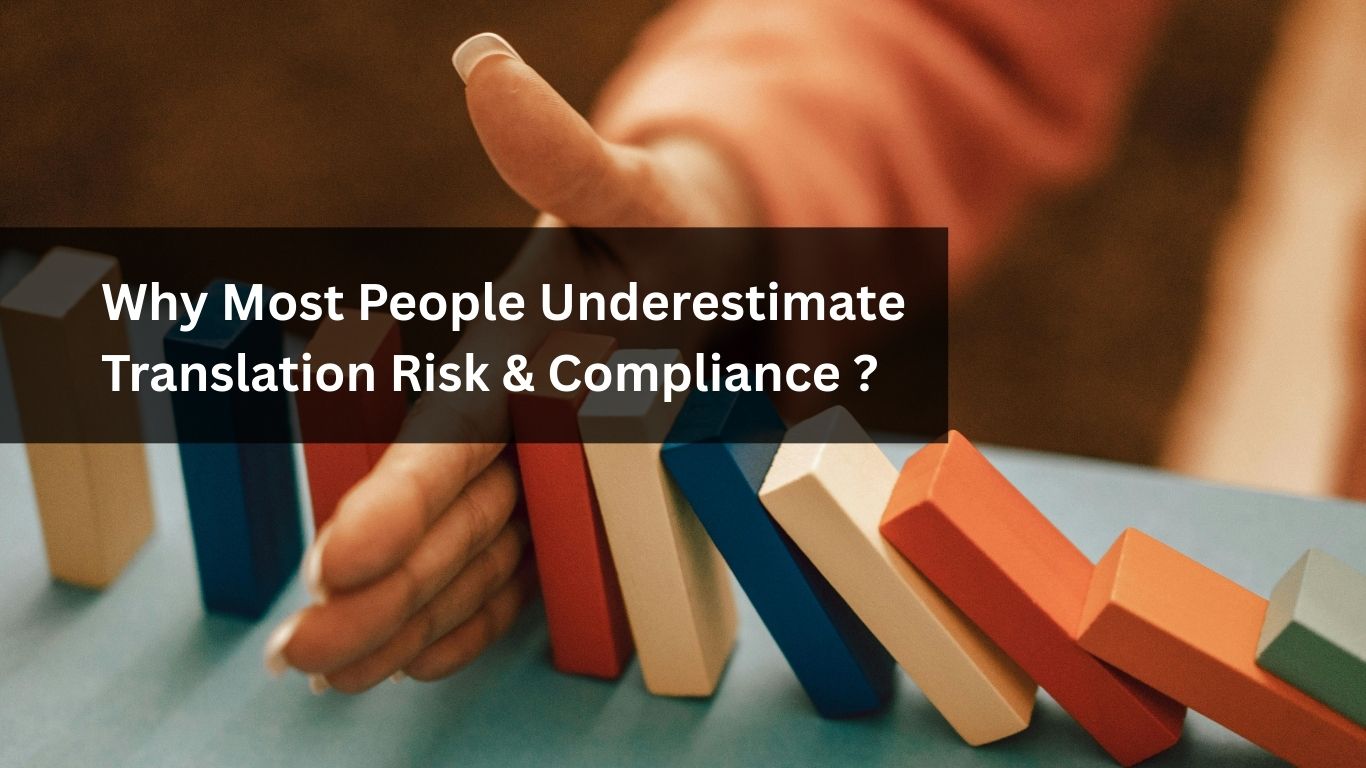
Why Most People Underestimate Translation Risk ?
(And How Quadrate’s Multilingual Business Translation Fix Everything)
Unlock Multilingual Communication with Accurate Localization & Translation Services
The Hidden Legal, Compliance, and Business Costs Nobody Warns You
Most people think translation is a support task.
Something you “get done” after the important decisions are made.
That assumption is expensive.
Translation is not a cosmetic layer added at the end of a process. It is a risk surface. When it fails, it doesn’t fail politely. It fails in courts, regulatory audits, customs offices, hospitals, product recalls, immigration rejections, and lost lawsuits. Yet translation risk is still treated as an afterthought, delegated to the cheapest vendor, rushed through machines, or handled by people with no accountability for downstream consequences.
This blog explains why translation risk is consistently underestimated, how it creates legal and compliance exposure, and why organizations that ignore it eventually pay far more than they save.

What Is Translation Risk (Really)?
Translation risk is the probability that a translated document, message, or interface will cause legal, regulatory, financial, reputational, or safety damage due to linguistic failure.
Not typos. Not “awkward phrasing.”
Actual damage.
Translation risk includes:
Legal misinterpretation
Regulatory non-compliance
Contractual ambiguity
Medical or safety errors
Data privacy violations
Brand misrepresentation
Search and visibility loss in global markets
And unlike many business risks, translation risk is silent until it explodes.
Why Translation Risk Is So Widely Underestimated
Language Feels Familiar, So People Assume It’s Easy
Everyone uses language every day. That familiarity creates false confidence.
Executives who would never edit source code, rewire a medical device, or reinterpret a tax regulation will confidently say things like:
“This looks fine to me.”
“Google Translate is pretty good now.”
“Our internal team can handle it.”
Language looks simple.
Legal, medical, and technical language is not.


Translation Errors Often Surface Too Late
Translation failures rarely show up immediately.
They appear when:
A regulator rejects a submission
A court challenges contract intent
A medical authority flags documentation
A customs office blocks shipments
A patient misunderstands instructions
A lawsuit asks “what did this clause mean?”
At that point, the translation budget is irrelevant. The damage is already done.
Organizations Confuse Cost Control With Risk Control
Saving money on translation feels efficient.
Until it becomes indefensible.
Cheap translation reduces cost visibility, not risk exposure. In fact, it increases risk by:
Removing QA layers
Eliminating subject-matter review
Relying on unverified linguists
Skipping compliance checks
Treating certification as optional
Risk doesn’t disappear because it’s cheaper. It compounds.


Legal Translation Risk Is Often Discovered During Disputes
This is the worst timing possible.
During litigation or arbitration:
Every word is scrutinized
Intent is reconstructed
Inconsistencies are weaponized
Translation quality becomes evidence
At that point, arguing “we used a low-cost vendor” is not a defense. It’s an admission.
Compliance Translation Risk:
Where Small Errors Become Big Violations
Compliance translation sits at the intersection of language and regulation, which makes it uniquely dangerous when mishandled.
Industries Where Compliance Translation Risk Is Highest
Medical devices and healthcare
Pharmaceuticals and clinical trials
Manufacturing and industrial safety
Financial services
Data protection and privacy
Immigration and government submissions
Regulators do not evaluate effort.
They evaluate accuracy, completeness, and conformity.
Common Compliance Translation Failures
Incorrect terminology not aligned with regulatory frameworks
Missing mandatory disclaimers or warnings
Improper formatting that violates submission standards
Inconsistent terminology across documents
Machine-translated regulatory language without validation
These errors do not trigger warnings. They trigger rejections, delays, audits, or penalties.


Digital Translation Risk:
SEO, Discoverability, and Brand Damage
Translation risk doesn’t stop at documents.
In digital ecosystems, poor translation causes:
Search invisibility
Low conversion rates
User distrust
Brand dilution
Why Machine-Only Website Translation Fails
Search engines and users do not reward literal translation.
Poor localization leads to:
Unnatural keyword usage
Misaligned search intent
Cultural disconnect
Lower dwell time and higher bounce rates
The result is silent failure. The site exists, but it doesn’t perform.
Where Professional Translation Partners Matter
A professional translation partner does more than convert text.
They:
Identify risk early
Flag ambiguity
Align terminology
Apply regulatory awareness
Deliver defensible output
This is where experienced providers like Quadrate differentiate themselves, not by promising perfection, but by engineering reliability into the process.
The Real Cost of Underestimating Translation Risk
Translation mistakes rarely cost what translation costs.
They cost:
Legal fees
Missed deadlines
Regulatory penalties
Market delays
Reputation damage
Operational disruption
And the most frustrating part?
Most of these costs were avoidable.

Conclusion
Request a quote. Submit documents securely. Get it right the first time.
Get Your Urgent Translation Now → [Upload Your File / Get a Quote]
Request a Free Quote Today | 24/7 Availability | Serving Pan-India & Worldwide Clients | Certified Translators & Localization Experts