
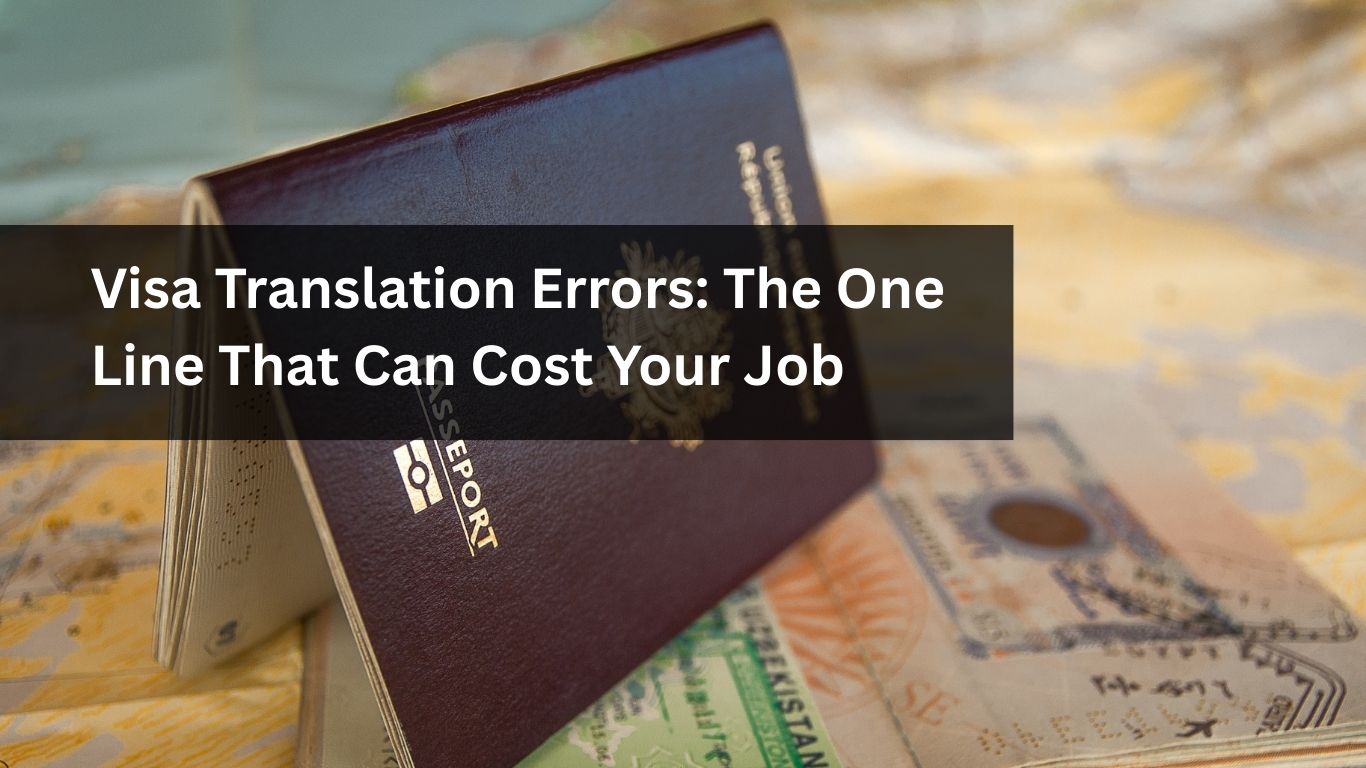
Visa Translation Errors : The One Line That Can Cost Your Dream Job in Dubai
(And How Quadrate’s Multilingual Business Localization Fix Everything)
Unlock Multilingual Communication with Accurate Arabic Localization & Translation Services
Every year, thousands of skilled professionals from India pack their hopes into a folder full of certificates and send them to Dubai, Abu Dhabi, Riyadh, Doha, or Muscat. Engineers, nurses, project managers, accountants, technicians, architects, IT professionals—you name it. Each one believes their qualifications and experience are enough to unlock a high-paying Gulf career.
What most people don’t know is this: it takes only one wrong translation line for a dream Dubai job offer to vanish.
A misinterpreted date. A mistranslated designation.
A missing phrase in a degree certificate.
A wrong spelling in an affidavit.
A mismatched name in an Arabic translation.
These errors look tiny. Embassies don’t think so. HR doesn’t think so.
Compliance departments definitely don’t think so.
If an Arabic translation or English document submitted for visa processing fails to match immigration standards, your file is rejected instantly—with no explanation and no second chance.
This blog explains the hidden side of Gulf recruitment:
why certified translation accuracy decides whether your dream job becomes a reality or disappears overnight.


Why a Single Translation Line Can Destroy a Visa Application
Dubai immigration rules are strict. The UAE, Saudi Arabia, Qatar, Oman, Bahrain, and Kuwait require documents to be perfectly translated—often into Arabic—before they are processed for work visas.
Even a minor mismatch triggers:
File rejection
Request for re-submission (delays of 2–6 weeks)
HR withdrawal of offer
Embassy red-flagging
Automatic cancellation of your visa slot
Common mistakes that cost people their jobs
- Wrong name order
Arabic formatting follows specific naming patterns.
If your father’s name or surname is placed incorrectly, the document gets rejected. - Translation of degree designations
Engineering specializations, medical titles, and technical roles must match recognized Arabic equivalents. - Date-format errors
DD/MM/YYYY vs. YYYY/MM/DD kills more applications than you think. - Mismatched spellings
Indian names vary across passports, certificates, and ID proofs. One mismatch leads to rejection. - Literal translation of legal terms
Legal and compliance requirements need contextual translation, not dictionary translation. - Incorrect certificate terminology
Birth, marriage, police clearance, experience letters—each has embassy-approved wording.
This is why certified translation is not optional.
It is the difference between “Visa Approved” and “Visa Cancelled.”
Why the Gulf Market Is Extremely Strict About Translation Accuracy
Dubai and other GCC nations rely on accurate documentation to prevent fraud and ensure compliance across industries such as engineering, oil & gas, construction, IT, healthcare, banking, and logistics.
These industries need:
Clear job titles
Accurate experience records
Verified educational qualifications
Legally compliant document translations
Embassy-approved formatting
In India, most rejected applications are directly tied to poorly translated documents done by:
Untrained freelancers
Automated tools
Low-cost agencies
Typists with no domain expertise
The Gulf does not compromise on documentation standards. Every translated document must:
Be certified
Be accurate
Match the original
Follow embassy formatting
Use correct legal and technical terminology
Pass verification checks
Failing these is enough for a job offer to be rescinded.


Documents That MUST Be Perfectly Translated for Dubai Jobs
1. Educational Certificates
Degree
Diploma
Mark sheets
Provisional certificates
A single mistranslated specialization can delay equivalency.
2. Experience Certificates
Company-issued letters
Job titles
Role descriptions
Tenure details
Arabic HR teams compare these line by line with your CV.
3. Police Clearance Certificate (PCC)
If “no criminal record” is not translated exactly as per regulatory format, it gets rejected.
4. Medical Reports
Used for residency and employment approvals.
Errors are treated as “invalid.”
5. Marriage & Birth Certificates
Critical for family visa and sponsorship.
6. Technical & Engineering Documents
Manuals, SOPs, machinery documents—must match global engineering terminology.
7. Legal & Compliance Documents
Affidavits, declarations, contracts, court abstracts—require legal-grade translation.
How Employers Verify Your Arabic or English Translations
Dubai HR and immigration authorities run multi-step verification:
- Cross-checking passport spellings
- Verifying dates & employment timelines
- Checking role titles against job descriptions
- Comparing translation with the original
- Running name-match validation across all documents
- Ensuring embassy-approved formatting
If a single inconsistency appears, HR is forced to withdraw the offer because:
They cannot reapply for you while a rejection flag exists
Visa slots are limited
Compliance penalties apply for incorrect paperwork
Your future in Dubai depends entirely on the precision of your translated documents.

Why Certified Translation Is the Only Acceptable Standard ?
A certified translation includes:
Translator’s seal
Translator’s signature
Statement of accuracy
Embassy-ready formatting
Matching terminology
Page-by-page mapping
Correct naming order
Verified spellings
Dubai immigration, MOFA, HR departments, and legal authorities accept only certified translations.
Certified translation:
Prevents rejection
Accelerates approval
Ensures compliance
Protects your job offer
Guarantees official acceptance
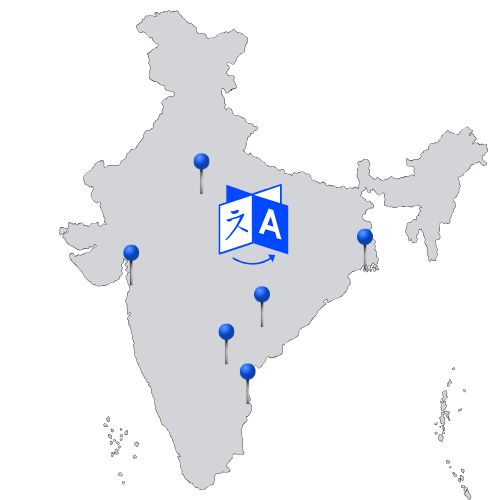
Regional & Language Expertise (India-Wide Coverage)
Demand for GCC migration is highest in:
South India
Chennai, Coimbatore, Trichy, Kochi, Trivandrum, Bangalore, Hyderabad, Vizag.
North & West India
Delhi, Noida, Gurgaon, Mumbai, Pune, Ahmedabad, Surat.
East India
Kolkata, Bhubaneswar, Guwahati.
High-Demand Languages for Arabic Translation
English
Tamil
Hindi
Malayalam
Telugu
Kannada
Urdu
Bengali
These language pairs drive most Dubai-bound documentation.

How Professional Translation (Quadrate)
Protects Your Dubai Career ?
1. Eliminates Visa Rejection Risk
Perfect translations ensure your documents pass instantly.
2. Speeds Up HR Processing
Employers prefer candidates whose documents are “ready-to-submit.”
3. Boosts Your Hiring Probability
Companies choose candidates who won’t face delays.
4. Prevents Embassy Red Flags
Mistakes accumulate in your immigration file.
5. Ensures Compliance Across Gulf Countries
Standards vary between UAE, Saudi, Qatar, Oman, and Kuwait.
The Translation Process (End-to-End)
- Document verification
- Terminology mapping
- Multi-stage translation
- Cross-lingual proofreading
- Format alignment
- Quality checks (legal, technical, linguistic)
- Certification
- Final delivery
Every line is double-checked before certification.


FAQs
1. Can poor translation really cause visa rejection?
Yes. It is one of the top reasons for visa delays and offer cancellations.
2. Does Dubai require certified translation?
Absolutely. Embassies and HR departments require certified and accurate documents.
3. How long does translation take?
1–3 days depending on document volume.
4. What languages are most in demand?
Arabic, English, Tamil, Hindi, Malayalam, Telugu, Kannada, Urdu, Bengali.
5. Can a translation mistake affect future visa filings?
Yes. It can create a permanent red flag in your immigration file.
Conclusion
Translation accuracy isn’t a small detail.
It is the one factor that decides whether you move to Dubai—or stay stuck at home watching your opportunity slip away.
One mistranslated line is enough to destroy your visa, your job offer, and your Gulf career.
Get it done right.
Get it certified.
Get it checked by professionals who understand the consequences of every single word.
Get Your Urgent Translation Now → [Upload Your File / Get a Quote]
Request a Free Quote Today | 24/7 Availability | Serving Pan-India & Worldwide Clients | Certified Translators & Localization Experts